The 2026 quarterback class entered the 2025 college season with sky–high expectations, boasting a group that looked deep, talented and loaded with future franchise passers. But as the year unfolded, the picture became far less flattering. Several of the early favorites struggled with consistency, decision–making or durability, while others weren’t as refined as their preseason buzz suggested.
In an era shaped by Name, Image, Likeness (NIL) leverage and the transfer portal, more quarterbacks are choosing to return to school rather than declare before they’re ready, prioritizing development over draft position. The result is a noticeably thinner class than many anticipated; one that lacks quantity, but still offers intriguing upside at the top. For those who have declared, the question now becomes simple: what separates them from the wave of talented passers who chose to wait?

The Top 5 Rookie Quarterbacks for the 2026 NFL Draft
1. Fernando Mendoza (Indiana Hoosiers)
Fernando Mendoza is a tall, poised quarterback prospect with advanced pocket feel, high–level processing and the mental makeup NFL franchises want leading their offense. Once a late scholarship gamble for the California Golden Bears, Mendoza has climbed from anonymity to Heisman Trophy winner. He’s now a projected top pick by thriving under pressure and consistently delivering in big moments. After proving he could produce behind one of the most battered offensive lines in college football at Cal, Mendoza took full control of Indiana’s offense and elevated it to national relevance. His combination of anticipation, accuracy and composure gives him one of the safest quarterback profiles in the 2026 class, with enough physical tools to support legitimate franchise–QB upside.
Strengths:
- Advanced pocket management: Navigates congestion with subtle movement, keeping his platform clean and his eyes downfield.
- Anticipation and touch: Releases the ball before windows open, especially in the intermediate area, allowing receivers to create yards after the catch.
- Field vision: Reads coverage quickly and works through progressions efficiently when his feet stay quiet.
- NFL size and presence: At 6’5”, he sees over traffic and delivers from multiple arm angles without sacrificing accuracy.
- Composure under fire: Took consistent punishment early in his career, yet never developed bad habits or panic in the pocket.
- Coverage manipulation: Uses eye discipline and body positioning to move defenders and create throwing lanes.
- Blitz recognition: Identifies pressure and punishes aggressive defenses with quick, decisive throws.
- Functional athleticism: Mobile enough to extend plays and punish defenses that turn their backs in coverage.
- Clutch performer: Plays his best football in high-leverage situations, showing command and confidence when games are on the line.
Concerns:
- Arm strength is good, not great: Can access all levels of the field, but lacks the effortless velocity of elite NFL throwers.
- Sack tendency: Too willing to try saving plays, leading to avoidable negative plays.
- Needs more functional mass: Will benefit from adding strength to handle NFL hits and maintain durability.
- Vertical résumé: Has not consistently been asked to drive the ball downfield in Indiana’s RPO-heavy structure.
- Footwork under pressure: Can get bouncy when his first read is taken away, disrupting timing and accuracy.
- Occasional forced throws: Will challenge coverage when patience would be the better option.
Overall Evaluation
Projecting as a high-end NFL starter, Fernando Mendoza has the intelligence, toughness and accuracy to be the centerpiece of a modern offense. He fits best in timing-based, rhythm passing systems that value anticipation and ball placement, but his size, pocket command and composure allow him to function in any pro scheme. While he may never be a pure arm-talent quarterback, his processing speed, situational awareness and calm under pressure give him both a high floor and a real franchise-quarterback ceiling.
If he sharpens his footwork and improves his willingness to live for the next down, Mendoza has the upside to be a long-term starter who consistently wins with efficiency, command and late-game execution. That’s the type of quarterback teams build around rather than replace.
2. Ty Simpson (Alabama Crimson Tide)
A polished, high-IQ quarterback prospect with advanced processing skills, Ty Simpson has refined pocket mechanics and the kind of football upbringing that shows up on tape. The son of longtime college coach Jason Simpson, he was raised inside meeting rooms and film sessions long before he ever took a varsity snap, and that foundation has shaped him into one of the most technically sound passers in the 2026 class. After patiently waiting behind Bryce Young and Jalen Milroe, Simpson finally took control of Alabama’s offense in 2025 and flashed both franchise-quarterback upside and first-year volatility. At his best, he operated the Crimson Tide offense with surgical precision, carving up elite defenses with timing, anticipation and command. At his worst, late-season pressure exposed physical and experiential limitations that still need refinement.
Strengths:
- Pre-snap command: Identifies coverages, sets protections and adjusts routes with veteran-level control at the line of scrimmage.
- Processing speed: Works through progressions rapidly, allowing secondary and tertiary reads to stay viable within structure.
- Pocket presence: Climbs and slides naturally, maintaining throwing posture while navigating edge pressure.
- Ball placement: Consistently hits receivers in stride, maximizing yards after the catch on short and intermediate routes.
- Mechanics and release: Compact, repeatable motion with a quick trigger that keeps timing intact against pressure.
- Coverage manipulation: Uses eyes and shoulders to move safeties and open throwing lanes, showing NFL-caliber nuance.
- Poise: Remains calm and decisive even when protection breaks down, rarely panicking into reckless throws.
- Leadership: Displays full control of the offense, commanding tempo and adjustments with confidence
Concerns:
- Average arm strength: Lacks elite velocity, particularly on deep and far-hash throws.
- Frame: Needs additional functional weight to handle sustained NFL contact.
- Deep-ball consistency: Leaves some explosive plays on the field due to touch and placement variance.
- Ball security: Late-season fumble issues raise durability and pressure-management concerns.
- Limited sample size: Only 15 career starts, with noticeable regression once defenses adjusted.
- Interior pressure: Struggles more when pushed up the middle, occasionally abandoning clean pockets instead of climbing.
Overall Evaluation
Looking to his future, Ty Simpson projects as a high-level processor and rhythm passer who fits best in a timing-based NFL offense that emphasizes structure, anticipation and decision-making. When protected and operating on schedule, he looks like a long-term NFL starter who can control games with accuracy, intelligence and precision. His ceiling is that of a franchise-level distributor in the mold of modern cerebral passers who win with their minds rather than raw physical tools.
However, his margin for error is narrower than that of quarterbacks with elite arm strength or athleticism. To reach his ceiling, Simpson will need a stable offensive line and a system that allows him to play within structure while also continuing to refine his anticipation and pocket discipline. In the right environment, he has the makeup and skill set to develop into a reliable, multi-year NFL starter; in the wrong one, his physical limitations could cap his impact.
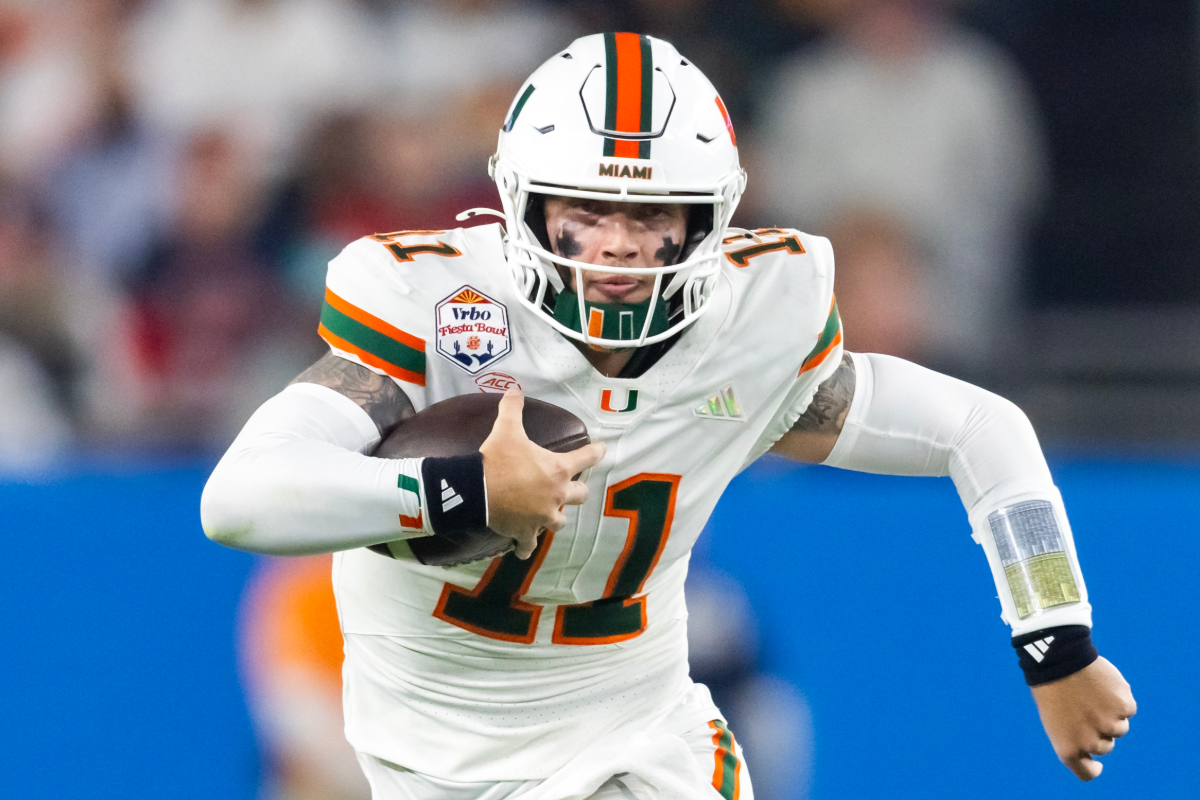
3. Carson Beck (Miami Hurricanes)
Carson Beck is a seasoned, rhythm-based quarterback with strong anticipation, refined mechanics and the kind of experience that NFL coaches value in a pro-ready passer. A former Florida “Mr. Football” who patiently
climbed the depth chart as a Georgia Bulldog before becoming a full-time starter, Beck rebuilt his draft profile at Miami, proving he could still operate a high-level offense after adversity and injury. With nearly 50 career appearances and over 35 starts, Beck enters the 2026 draft as one of the most battle-tested quarterbacks in the class. He wins with timing, accuracy and poise from the pocket rather than raw athleticism, giving him a clear projection as a distributor who can keep an offense on schedule when surrounded by structure and protection
Strengths:
- Anticipation and timing: Throws receivers open before their breaks, especially on rhythm concepts and in-breaking routes.
- Ball placement: Consistently puts the ball on the proper shoulder or hip, maximizing catchability and yards after the catch.
- Pocket discipline: Slides, shuffles and climbs the pocket while keeping his eyes downfield.
- Processing speed: Identifies coverage and mismatches quickly, allowing him to get the ball out on time.
- Release mechanics: Compact, repeatable motion that delivers the ball efficiently from multiple arm angles.
- Layered touch: Shows feel for trajectory, dropping passes over linebackers and in front of safeties in zone coverage.
- Experience and composure: Has seen every defensive look imaginable and remains steady in high-leverage situations.
- Situational execution: Demonstrated late-game poise during Miami’s playoff run, including converting critical downs under pressure.
Concerns:
- Deep-ball consistency: Vertical accuracy remains streaky despite adequate arm strength.
- Interior pressure: Struggles most when pushed off his spot from the middle, leading to rushed or off-platform throws.
- Turnover risk: Has a history of forcing throws into coverage when plays break down.
- Limited athleticism: Offers little as a designed runner and only modest escapability.
- Physical ceiling: Above-average arm and mobility, but not special traits that allow him to overcome poor surroundings.
- Past injury: Elbow and shoulder issues add some durability questions.
Overall Evaluation
Projecting as a pro-ready, point-guard style quarterback, Carson Beck would fit best in a timing-based passing offense built around anticipation, rhythm and quick decision-making. He has the experience, poise and accuracy to step into an NFL lineup early and operate an offense efficiently when protected and supported by strong skill talent. While he may never be a high-ceiling, off-script creator, his ability to manage games, distribute the football and keep drives alive gives him a clear path to becoming a quality NFL starter.
In the right environment, Beck can be the steady hand that wins games with consistency and command. In less stable situations, his lack of elite physical tools and susceptibility to pressure could cap him as more of a high-end game manager than a franchise elevator.
4. Garrett Nussmeier (LSU Tigers)
A confident, rhythm-based quarterback with natural throwing instincts, Garrett Nussmeier has high-level processing and the competitive edge of a lifelong football quarterback. The son of longtime NFL and college coach Doug Nussmeier, Garrett was raised around offensive systems and defensive structure, and it shows in the way he commands an offense. After waiting behind Jayden Daniels, he took over LSU’s attack in 2024 and quickly became one of the SEC’s most productive and aggressive passers. A timing-and-anticipation thrower with enough mobility to extend plays, Nussmeier plays with a gunslinger’s mentality inside a structured passing offense. When he’s in rhythm, he can dissect coverage and deliver strikes to every level of the field, but his aggressive nature also brings volatility.
Strengths:
- Natural thrower: Generates easy velocity and spin, allowing him to make layered throws without straining his mechanics.
- Anticipation and ball placement: Throws receivers open, especially on in-breaking routes and intermediate concepts.
- Quick processor: Diagnoses coverage quickly and gets the ball out on time, particularly in RPO and rhythm passing concepts.
- Blitz awareness: Identifies pressure packages and replaces blitzers with the football.
- Pocket composure: Maintains vision and mechanics when edge pressure closes in.
- Throwing on the move: Delivers accurate passes while rolling out, keeping his shoulders square to targets.
- Competitive toughness: Willing to stand in and take hits to deliver throws in big moments.
- Leadership: Brings confidence and energy to the huddle, with teammates responding to his intensity.
Concerns:
- Lean frame: Needs added mass to withstand NFL-level punishment.
- Risk-taking: Will force throws into coverage instead of taking easy completions.
- Progression discipline: Can lock onto his first read and miss open receivers elsewhere.
- Disguised coverages: Can be fooled by late safety rotations and post-snap movement.
- Interior pressure: Tends to drift when pushed from the middle, leading to erratic throws.
- Arm strength limits: Adequate but not elite; late throws can hang against tight coverage
Overall Evaluation
Garrett Nussmeier projects as a capable NFL spot starter and high-end backup who can step into a lineup and win games when called upon. His anticipation, accuracy and command of a passing structure allow him to operate an offense efficiently in short stretches, particularly in systems built around timing and quick reads.
However, his limited mobility and lean frame place a firm ceiling on his long-term upside. He is unlikely to be a quarterback who elevates a struggling roster or consistently creates outside of structure, and durability concerns make it difficult to project him as a multi-year full-time starter. In the right environment, with protection, rhythm-based concepts and quality weapons, Nussmeier can be a reliable plug-and-play option. But his profile ultimately fits best as a strong backup quarterback who can keep a team competitive rather than a franchise cornerstone.
5. Cade Klubnik (Clemson Tigers)
Cade Klubnik is a high-upside dual-threat quarterback with rare arm talent, explosive athleticism and a volatile production profile that reflects both his ceiling and his inconsistency. A former five-star recruit and three-time Texas state champion, Klubnik arrived at Clemson with immense expectations and has spent the last three seasons flashing the traits of a modern NFL playmaker while still searching for week-to-week stability.
At his best, Klubnik is an electric weapon who can threaten defenses with both his arms and legs, creating explosive plays when structure breaks down. At his worst, his footwork, processing and pocket composure betray him, leading to stalled drives and turnover-worthy decisions.
Strengths:
- Elite arm talent: Can generate velocity, touch and accuracy from multiple platforms, making difficult throws look easy.
- Dynamic athleticism: Legitimate running threat who forces defenses to account for him in the ground game and on broken plays.
- Vertical passing ability: Throws seams, posts and deep in-breakers with confidence and accuracy.
- Off-platform creativity: Delivers accurate throws while moving, keeping plays alive when protection fails.
- Quick release: Compact, fast arm action that helps him survive pressure.
- Play-action/RPO weapon: Thrives when defenses are stressed and forced to declare coverage.
- Toughness and competitiveness: Will stand in against contact and continue to fight when games get tight.
- Big-game experience: Has delivered in high-leverage ACC and playoff moments.
Concerns:
- Inconsistent processing: Struggles with post-snap rotations and disguised coverages.
- Footwork and base: Too often throws without setting his feet, relying on arm talent instead of mechanics.
- Decision-making: Will force throws into dangerous windows when pressured.
- Pocket composure: Can get frantic when interior pressure arrives.
- Short-area accuracy: Needs better consistency in the quick game.
- Lean frame: Needs added strength to handle NFL punishment.
Overall Evaluation
Projecting his outlook, Cade Klubnik is a developmental quarterback with starter traits who profiles best as a high-end backup early in his career. His arm talent and athleticism give him legitimate upside. In a well-designed system that emphasizes play-action, RPOs and movement, he could eventually grow into a starting-caliber NFL quarterback. However, the inconsistency in his processing, footwork and decision-making creates real risk, making him better suited to enter the league behind an established starter.
If his game stabilizes, Klubnik has the tools to become a dynamic NFL starter. If not, his athleticism and arm will still allow him to function as an effective backup quarterback who can win games in short stretches.
Notable Other Quarterbacks
- Drew Allar (Penn State Nittany Lions): Drew Allar is a traits-based quarterback whose draft value is driven almost entirely by his arm and frame rather than his reliability.
- Diego Pavia (Vanderbilt Commodores): A role-specific, developmental quarterback, Diego Pavia is best suited for spread and movement-based offenses that lean into quarterback mobility and improvisation.
- Cole Payton (North Dakota State Bisons): Cole Payton projects as a mid to late round developmental quarterback with one of the highest physical ceilings in the class.

Thanks for reading about my Top 5 Rookie Quarterbacks for the 2026 NFL Draft! For more Devy and College Fantasy Football content, follow me on Twitter/X @PoshplaysFF.
*Photo Credit: Mark J. Rebilas – USA TODAY Sports*
