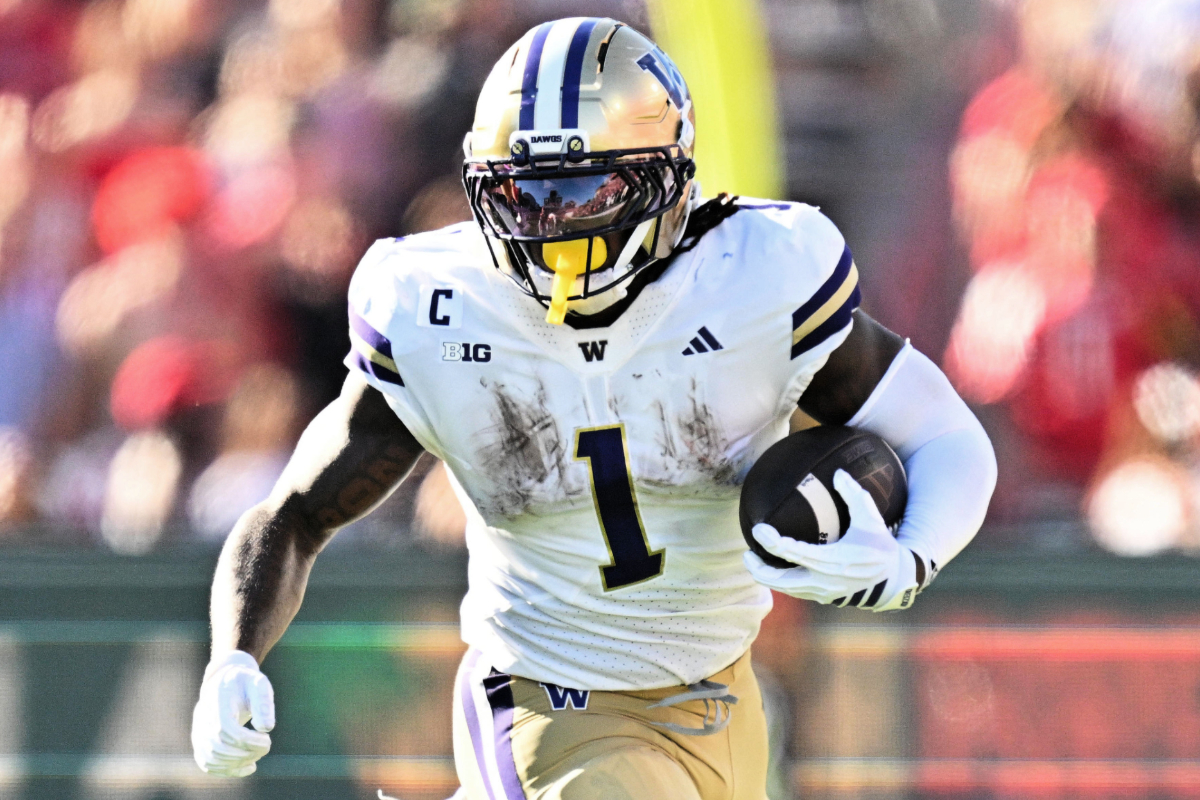
The 2026 running back class arrives in stark contrast to 2025, which will likely be remembered as one of the deepest and most talent-rich groups the position has produced in recent memory. Where last year featured multiple plug-and-play stars, tiered depth and a wave of NFL-ready contributors, this cycle feels notably thinner and more dependent on context.
Beyond one clear superstar-in-waiting at the top, the remainder of the class is far more projection-based, filled with players whose NFL impact will hinge heavily on scheme, role and landing spot rather than overwhelming individual dominance. The depth of blue-chip talent and day-one difference-makers simply doesn’t match what we saw a year ago, however, there are plenty of useful backs who can carve out meaningful roles.

The Top 7 Rookie Running Backs for the 2026 NFL Draft
1. Jeremiyah Love (Notre Dame Fighting Irish)
Jeremiyah Love is a rare blend of home-run speed, natural feel for the position and three-down versatility that fits perfectly with how modern NFL offenses want to deploy running backs. A big-play back who can stress defenses from snap to snap, Love combines explosive acceleration with legit receiving ability, making him dangerous whether he’s carrying the ball or flexed into space. His combination of vision, open-field creativity and finishing ability gives him true difference-maker upside in the league. Love carried the load for Notre Dame in 2025, posting 1,372 rushing yards on 199 carries (6.9 YPC) with 18 touchdowns, while adding 27 receptions for 280 yards and three more scores. He proved he could handle volume, produce week to week and still deliver explosive plays against top competition.
Strengths:
- Home-run speed: A track-verified game-breaker who can score from anywhere; accelerates instantly and sustains elite top-end speed in the open field.
- Rare contact balance for a speed back: Stays on his feet through glancing blows, keeps momentum and rarely loses velocity on first contact.
- Natural pass-catcher: Soft hands, smooth transitions from receiver to runner and excellent vision after the catch turn checkdowns into chunk gains.
- Electric open-field creativity: Can juke, hurdle or hit a second gear that makes pursuit angles look foolish.
- Runs with surprising power: Lowers his pads, finishes runs and consistently falls forward despite a leaner frame.
- High-level vision: Patient runner in zone schemes who sets up blocks and finds creases between the tackles.
- True three-down weapon: Comfortable aligning in the backfield, slot or out wide without tipping play calls.
- Exceptional ball security: Has carried the ball hundreds of times without a fumble, showing strong ball control despite his highlight-reel style.
Concerns:
- Pass protection needs work: Lacks consistent anchor strength against NFL edge rushers; technique and willingness must improve.
- Durability questions: At roughly 206 pounds, some teams may hesitate to give him a true bell-cow workload.
- Route polish still developing: When split wide, his route tree leans toward straight-line concepts rather than nuanced stems and breaks.
- Vision on gap schemes: Can miss cutback lanes on power/counter concepts when pullers create backside opportunities.
- Hurdling habit: Spectacular, but risky; exposes him to big hits and awkward landings
Overall Evaluation
Jeremiyah Love projects as a high-end starting back with Pro Bowl upside in the right offense. His best fit is in a scheme that gets him into space, with wide zone, outside runs, RPO looks and creative passing game usage out of the backfield. He is a back who changes how defenses have to play, stretching them horizontally and vertically on every snap. He is unlikely to be a traditional “between-the-tackles grinder,” but he doesn’t need to be. In today’s NFL, Love’s blend of efficiency, explosiveness and receiving value is more valuable than sheer size. With continued refinement in pass protection and route running, he has the ceiling to be a true offensive centerpiece, a back who can pile up rushing yards, rack up receptions and score in bunches.
2. Jadarian Price (Notre Dame Fighting Irish)
Jadarian Price is an explosive, decisive running back whose best trait is how quickly he can turn ordinary looks into big plays. He brings legitimate home-run speed, natural instincts and enough physicality to run between the tackles, making him more than just a change-of-pace option. While his workload history and pass protection remain questions, his three-down traits and special-teams value give him a clear path to early NFL snaps.
Strengths:
- Violent runner through contact: Runs with controlled aggression, consistently breaking arm tackles and finishing forward.
- Patience and burst: Sets up blocks with excellent feel before exploding through creases and beating linebackers to the edge.
- Elite contact balance: Rare ability to stay on his feet; routinely gains hidden yards after first contact.
- True home-run speed: Legitimate 4.4 track speed that shows up on film once he reaches the second level.
- Natural receiver: Soft hands, smooth routes and comfortable aligning in space or splitting out wide.
- Outstanding vision: Instinctively finds cutback lanes and creates yardage where little exists.
- Special teams weapon: Dangerous kick returner with elite acceleration and field vision.
- Ball security under duress: Generally protects the football well despite a physical running style.
Concerns:
- Narrower frame: Still somewhat lean through the core, raising durability questions with heavy NFL workloads.
- Pass protection is a work in progress: Needs better technique and recognition to be trusted on third downs.
- Limited feature-back sample: Only one true season of high-volume carries to evaluate.
- Occasional hesitation: Can dance behind the line when reads get muddy instead of hitting designated lanes.
- Achilles history: Serious past injury will always be noted, even though he’s shown no lingering effects since 2023
Overall Evaluation
Projecting as a dynamic rotational back, Jadarian Price has starter upside in the right system. His best fit is in a zone-based offense that gets him on the perimeter and lets him use his acceleration and vision. He can also immediately contribute as a kick returner, which boosts his value. He is unlikely to be a 20–25 touch workhorse, but he can be a highly productive 10–15 touch per game back who flips field position and wins matchups in space.
3. Jonah Coleman (Washington Huskies)
A compact, powerful runner, Jonah Coleman wins with vision, balance and consistency rather than raw athleticism. He is the type of back who makes offensive lines look better by consistently maximizing what is blocked and squeezing out extra yards after contact. Coleman’s game is built for structure; he thrives in defined schemes where patience, leverage and decisiveness matter more than speed.
Strengths:
- Built-in leveler between the tackles: Compact, dense frame allows him to run through contact like a bowling ball, consistently falling forward and rarely going down on first contact.
- Elite vision in zone schemes: Patient runner who presses the line, reads leverage and hits cutback lanes with excellent timing.
- Outstanding ball security: Just one fumble on 396 career touches, a level of reliability that NFL teams covet in high-leverage situations.
- Sneaky burst for his build: Not a burner, but accelerates cleanly through creases and reaches the second level faster than expected.
- Crafty footwork in traffic: Keeps his feet active through contact, weaving through trash without losing momentum.
- Natural receiver out of the backfield: Soft hands, clean catch technique and smooth transition from catch to run.
- Surprising wiggle for a power back: Can make the first defender miss while maintaining north-south momentum.
- Mental toughness: Never flinched behind shaky offensive line play, just kept grinding and producing.
Concerns:
- Limited top-end speed: Will get caught from behind in the NFL and is unlikely to produce many true homerun runs.
- Pass protection inconsistencies: Willing, but technique can be sloppy; tends to drop his eyes and lose leverage at contact.
- Height creates blitz-recognition issues: Can get swallowed up in traffic and miss late blitzers.
- Lateral agility is good, not special: Won’t consistently win in a phone booth against NFL athletes.
- Route tree remains basic: More of a checkdown option than a true matchup piece in the passing game.
Overall Evaluation
Jonah Coleman projects as a steady, reliable early-down starter or high-end committee back. His style translates best to zone-heavy schemes that let him read and react rather than rely on pure explosiveness. He is unlikely to be a splash-play back, but he will consistently keep offenses on schedule. His upside resembles backs like Mike Davis or David Montgomery, not elite athletes, but productive, dependable runners who carve out long NFL roles through toughness and technique.
4. Emmett Johnson (Nebraska Cornhuskers)
Emmett Johnson is a smooth, agile and highly productive running back whose game is built on vision, balance and lateral quickness rather than pure size or straight-line speed. A true do-it-all back in Nebraska’s offense, he combined volume production with receiving value, proving he can stay on the field in every situation. Johnson’s ability to make defenders miss in space, pair patience with burst and contribute meaningfully in the passing game makes him one of the most complete backs in this class.
Strengths:
- Advanced vision and patience: Consistently presses the line of scrimmage, sets up blocks and identifies lanes before they fully develop.
- Elite lateral agility: Possesses a twitchy lower half that allows him to string together jump cuts, bounce runs outside the tackle box and make defenders miss in space.
- Scheme versatility: Proven success in inside zone, outside zone and duo concepts; reads keys cleanly and makes decisive bounce-or-bang decisions.
- Legitimate pass-game weapon: 46 receptions in 2025; runs real routes, catches cleanly away from his frame and turns checkdowns into chunk plays.
- Gets skinny through creases: Minimizes his strike zone, slipping through tight spaces and avoiding clean shots from defenders.
- Plus contact balance for his size: Pinballs off arm tackles, keeps legs churning and consistently gains hidden yards after first contact.
- Second-level burst: Once a crease appears, he accelerates quickly, turning modest gains into chunk plays.
- Proven durability and stamina: Handled heavy late-season workloads and produced eight 100-yard games without fading down the stretch.
Concerns:
- Pass protection still developing: High effort, but technique lags; struggles to anchor against bull rushers and needs cleaner blitz recognition.
- Occasional home-run hunting: Can overcommit to cutbacks rather than planting and getting vertical for available yardage.
- Adequate, not elite speed: Won’t consistently outrun NFL pursuit to the edge or take many runs the distance.
- Slight frame at 200 pounds: Raises questions about a true bell-cow role, especially in short-yardage and goal-line situations.
- Average power at the point of attack: Not a pile-mover; will win with finesse more than brute force.
Overall Evaluation
Looking to his future, Johnson projects as a high-end rotational starter with upside in the right system. His best fit is in a zone-heavy offense that lets him press the line, read blocks and use his elite lateral agility in space. He should immediately contribute as a receiving back on third downs and in two-minute situations.
Emmett Johnson is unlikely to be a traditional 20–25 carry workhorse or a short-yardage hammer, but he can be a 12–18 touch per game back who consistently moves the chains and creates explosive plays in space. In the right scheme, he has the ceiling of an above-average starter who can rack up both rushing and receiving production. He looks like a modern back who wins with feel rather than brute force.
5. Nicholas Singleton (Penn State Nittany Lions)
Nicholas Singleton is a rare athlete at running back: big, fast and powerful. His physical tools look like they were built in a lab; he has the kind of physical profile that makes scouts stop their film and start their stopwatch. On highlight tape, he appears unstoppable, with explosive burst, long speed and the kind of contact strength that overwhelms defenders. The challenge is that his production has not always matched his traits, and on All-22 film, his feel for the position has often lagged behind his athletic gift.
Strengths:
- Rare physical profile: Size, speed and raw power combination that few backs in any draft class can match. He looks the part of an NFL starter before he ever touches the ball.
- Immediate burst: When a crease appears, he hits it violently and reaches the second level faster than most linebackers can react.
- Downhill finishing power: Runs with squared shoulders and converts speed to force; effective in short yardage when deployed straight ahead.
- Versatile receiver: Comfortable flexing out wide or into the slot; tracks the ball well downfield for a back of his size.
- Home-run potential every snap: Forces defenses to respect the edge, stretching fits and creating space for complementary runners.
Concerns:
- Inconsistent vision: The core issue; Singleton’s processing as a runner is uneven, particularly in zone schemes. Too often, he plays at one speed — fast — rather than allowing blocks to develop. He will outrun his reads, miss cutback lanes or bounce plays prematurely instead of taking clean yardage that’s there.
- Highlight versus All-22 problem: On clips, he looks unstoppable. On full-game tape, the story is messier. Big runs can mask how frequently production is blocked for him rather than created by him. This is a classic prospect whose testing numbers and highlights can mislead evaluators.
- Straight-line runner: He is not a natural lateral creator. In tight spaces or against backfield penetration, he struggles to string together quick cuts. If defenders knife into the backfield early, plays die quickly.
- Patience is sporadic: He hunts explosives rather than consistently staying on schedule. That mentality produces splash plays, but also drive-killing losses.
- Production hasn’t matched traits: For a back with his athletic gifts, year-to-year production has been more volatile than expected. The senior season touchdown spike looks good on paper, but doesn’t erase broader concerns.
Overall Evaluation
Ultimately, Nicholas Singleton is the kind of running back that will get drafted higher than I would personally rank him. Teams will fall in love with the size-speed-power combination and convince themselves that “coaching the vision” is easier than it is. In a gap/power offense that lets him run downhill with limited reading responsibility, he can absolutely be productive and explosive. However, the risk is that in wide-zone or read-heavy systems, his lack of natural feel for creases and cutback lanes will lead to too many negative plays and stalled drives. He wins when the picture is clean; he is far less reliable when it isn’t. I see a player who will likely be overdrafted because of testing numbers and highlights. The tools are undeniable, but Singleton’s feel for the position is not.
6. Kaytron Allen (Penn State Nittany Lions)
A patient, decisive, downhill runner, Kaytron Allen’s game is built on vision, contact balance and reliability rather than eye-popping athletic traits. He wins with technique, leverage and a feel for run schemes, and his consistent production in a timeshare shows he can thrive in the NFL’s committee environment. Allen may not test like a star, but his play style translates: he is a dependable early-down back who consistently turns blocked yards into real yards and often more.
Strengths:
- Natural downhill runner: Plays with urgency and forward momentum, consistently attacking creases rather than dancing behind the line.
- Outstanding contact balance: Runs through arm tackles, keeps his feet churning and routinely finishes runs falling forward.
- Vision and patience: Reads blocks cleanly on both gap and zone concepts, pressing the line before committing to a lane.
- Short-yardage weapon: Thrives in goal-line and third-and-short situations, finding microscopic creases and converting through sheer leg drive.
- Compact, powerful frame: Thick lower half allows him to absorb punishment without losing balance or momentum.
- Surprisingly quick feet for his size: Not elusive, but nimble enough to navigate traffic in tight spaces.
- Ball security: Reliable ball carrier who protects the football well through contact.
- Scheme versatility: Can operate in gap, duo or zone systems without needing to be protected schematically.
Concerns:
- Lacks true home-run speed: Will not consistently outrun NFL secondaries; long runs are more about blocking than burst.
- Limited receiving upside: Functional hands-on checkdowns and screens, but not a route-running threat.
- Pass protection is a work in progress: Willing but technically inconsistent, sometimes lunges rather than anchors.
- Athletic ceiling is capped: Quicker than fast, which limits big-play potential and reduces his appeal to traits-driven teams.
- Not a creative open-field runner: Wins with power and efficiency, not shake or deception.
Overall Evaluation
Allen understands leverage, run lanes, and how to maximize what is blocked in front of him. He consistently hits the right hole, runs with controlled aggression and squeezes every yard out of a play. Allen projects as a rock-solid early-down back who can contribute immediately and stick in the league for a long time. His upside resembles that of Kyren Williams or Tyler Allgeier, as he’s not a flashy athlete, but he is a productive, reliable runner who can handle real carries and move the chains. He is best in offenses that value patience, physicality, and structure, particularly zone-based run games that let him read and react. Expect him to be a Day 3 pick who quickly becomes a trusted rotational back, short-yardage option, and late-game closer. If he lands with the right team, Kaytron Allen could carve out a multi-year role as a steady, winning player, even if he’s never a highlight-reel star.
7. Demond Claiborne (Wake Forest Deamon Deacon)
Demond Claiborne is a twitchy, space-creating running back who wins with elite change of direction, vision and big-play juice rather than size or power. A natural open-field weapon, he stresses defenses horizontally before turning upfield, and his ability as a returner gives him immediate two-phase value on Sundays. After a breakout season in 2024, Claiborne delivered steady efficiency in 2025, with 907 rushing yards on 179 carries (5.1 YPC) with 10 touchdowns, plus 10 kick-off returns, including a 96-yard house call, proving he can be productive even when defenses key on him.
Strengths:
- Elite lateral quickness and change of direction: Claiborne can stop, redirect and accelerate in a phone booth, making first defenders miss with regularity.
- Outstanding feel for space: He presses the line with patience, sets up blocks and consistently finds daylight where others wouldn’t.
- Above-average contact balance for his size: He doesn’t shy away from traffic and routinely bounces through arm tackles.
- Explosive burst once he commits: He accelerates through creases and reaches the second level quickly.
- Natural receiver out of the backfield: Soft hands, fluid movements and clear potential to be more than a checkdown option.
- Immediate special teams value: Proven kickoff returner with multiple house calls; this alone helps him make an NFL roster.
- Crafty runner behind the line: Uses subtle shoulder dips, footwork and tempo changes to manipulate defenders.
- Comfortable in congestion: Can “get skinny” through tight spaces and keep his balance where bigger backs would get swallowed up.
Concerns:
- Undersized for NFL interior work: At under 200 pounds, he will not be a short-yardage or goal-line back.
- Pass protection is a major question: Willing, but technically raw and physically overmatched against blitzers.
- Good, not elite, top-end speed: He creates chunk plays, but he gets caught more than you’d like on long runs.
- Can overthink runs: Occasionally too patient; he dances instead of planting and getting downhill.
- Limited power at the second level: When momentum stalls, he struggles to run through NFL-caliber tacklers.
Overall Evaluation
Projecting as a Day 3 rotational back with immediate special-teams value, Demond Claiborne does have a clear path to a meaningful offensive role in the right scheme. He is best suited as lightning in a thunder-and-lightning committee, paired with a bigger, between-the-tackles back. Offenses that feature wide zone, sweeps, motion and screens will maximize his strengths. Expect him to contribute early on kick returns and third downs, with upside as an 8–12 touch-per-game playmaker who can flip field position and steal explosive plays. Claiborne is not a volume bell cow, but in the right system, he can be a dangerous matchup piece who forces defensive coordinators to account for his speed and elusiveness every snap.
Notable Other Running Backs
- Le’Veon Moss (Texas A&M Aggies): Le’Veon Moss projects as a physical early-down back with starter upside in the right system
- Mike Washington Jr. (Arkansas Razorbacks): Mike Washington Jr. profiles as a high-upside RB2 with starter traits in the right scheme.
- Desmond Reid (Pittsburgh Panthers): Desmond Reid projects as a high-impact rotational weapon rather than a traditional every-down running back.

Thanks for reading my Top 7 Rookie Running Backs for the 2026 NFL Draft! For more Devy and College Fantasy Football content, follow me on Twitter/X @PoshplaysFF.
*Photo Credit: Jamie Sabau – USA TODAY Sports*
