Tight end continues to be one of the fastest-evolving positions in the modern NFL, and this class reflects that trend once again. While there is likely only one 2026 NFL Draft Day 1 lock at the top of the board, the real strength of this group lies in its depth across Day 2 and Day 3, where teams will find a wide range of skill sets and developmental profiles.
This class is rich in movement tight ends, seam-stretchers, red zone specialists and hybrid “big slot” types. There are fewer traditional in-line maulers, but plenty of players who can stress defenses in space. Many of these prospects bring system-specific traits that could look modest in one offense and flourish in another, making scheme fit and coaching particularly important in projecting their NFL outcomes.

The Top 7 Rookie Tight Ends for the 2026 NFL Draft
1. Kenyon Sadiq (Oregon Ducks)
A dynamic, movement tight end prospect, Kenyon Sadiq brings rare speed, explosiveness and alignment versatility to an NFL offense. At his best, he functions as a true mismatch creator, stressing defenses vertically down the seam and horizontally when flexed into the slot or split wide. Oregon leaned into his versatility, deploying him across the formation and asking him to win against linebackers, safeties and nickel defenders. His combination of burst, body control and natural ball tracking makes him a quarterback-friendly target at all three levels, while his growth and physical development has unlocked a higher ceiling as a receiver.
Strengths:
- Seam speed: Threatens defenses vertically and can stack second-level defenders with legitimate long speed.
- Separation ability: Shows quick feet and snaps in and out of breaks to create space against man coverage.
- Hands through contact: Plucks the ball cleanly in traffic and finishes catches with defenders closing.
- Body control at the catch point: Adjusts well to off-target throws and wins along the boundary.
- Alignment versatility: Comfortable in-line, in the slot, or detached from the formation.
- After-catch explosiveness: Builds speed quickly and turns short gains into chunk plays.
- Spatial awareness versus zone: Finds windows and presents an easy target over the middle.
Concerns:
- Functional strength as a blocker: Not yet built to hold up against NFL edge defenders consistently.
- Blocking technique: Can lose leverage and overextend rather than sustaining with foot drive.
- Release versus physical coverage: Needs counters when defenders disrupt timing at the line.
- Focus drops: Occasional concentration lapses on routine throws.
- Consistency in feeling zone coverage: Can settle instead of working to maximize separation.
Overall Evaluation
Kenyon Sadiq projects as a featured receiving tight end who can stress coverage from multiple alignments and serve as a primary matchup piece in the passing game. Early in his career, he profiles best in a role that prioritizes movement, seam threats and schemed touches rather than heavy in-line blocking responsibilities. With continued development as a blocker and refinement in his releases, Sadiq has the upside of a high-end NFL starter who tilts coverage and becomes a focal point in the red zone and intermediate passing game.
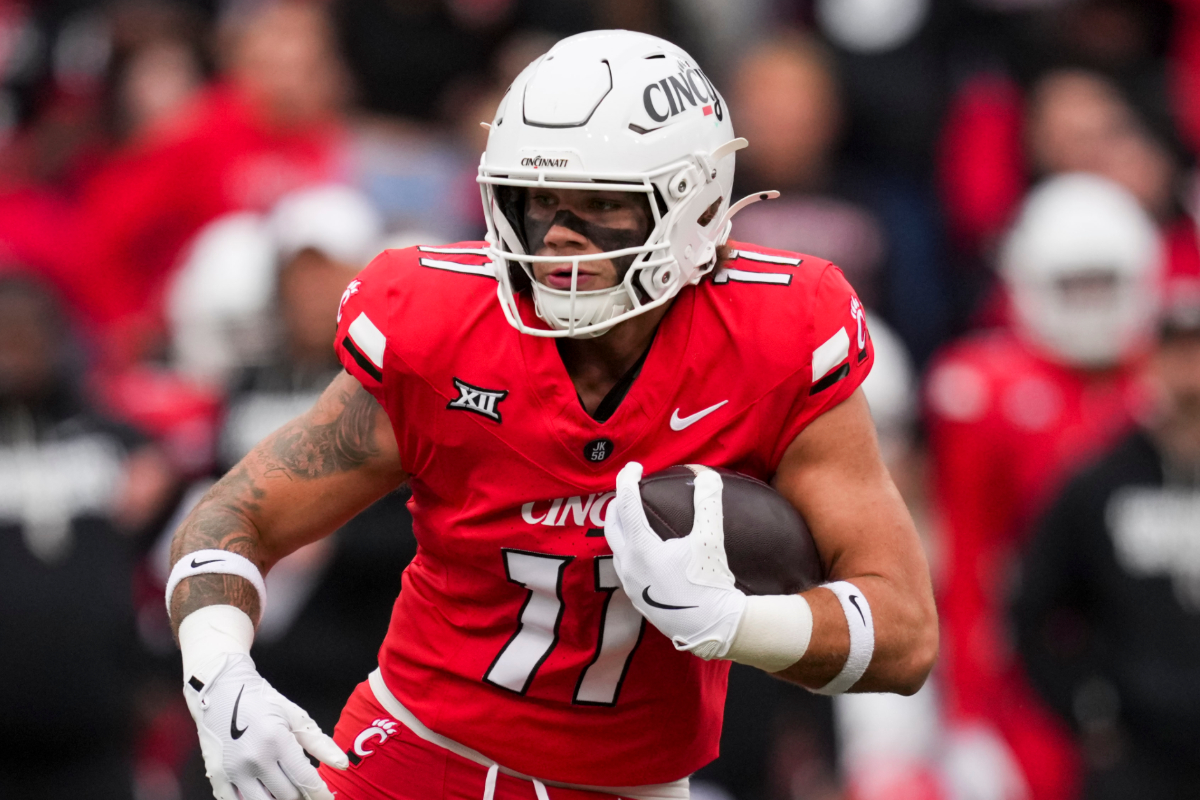
2. Joe Royer (Cincinnati Bearcats)
Joe Royer is a reliable, quarterback-friendly tight end prospect who wins with feel for space, soft hands and strong body control rather than his overwhelming athletic traits. He profiles as a chain-moving receiving tight end who can work the intermediate areas of the field and serve as a dependable safety valve over the middle. Royer’s game is built on timing and spatial awareness; he understands how to uncover against zone coverage, throttling down in windows and presenting clean throwing lanes for his quarterback. While he isn’t a rare movement athlete, his route discipline and subtle tempo changes allow him to create functional separation against linebackers. After the catch, he runs with an edge, fighting through arm tackles and consistently falling forward to extend plays.
Strengths:
- Hands and catch radius: Soft, reliable hands with the ability to secure throws in traffic and outside his frame.
- Body control: Adjusts naturally to off-target throws and maintains balance through contact.
- Zone awareness: Finds soft spots in coverage and becomes an easy outlet on timing concepts.
- Route discipline: Uses pacing and subtle head fakes to move defenders off leverage points.
- Yards after contact: Competes as a finisher, fighting for extra yards through arm tackles.
- Functional speed: Play speed shows up on tape, allowing him to stress intermediate zones.
- Growth trajectory: Clear year-over-year improvement suggests developmental upside remains.
Concerns:
- In-line blocking strength: Lacks consistent hand placement and leverage at the point of attack.
- Functional play strength: Needs a stronger base to anchor against NFL edge defenders.
- Route sharpness: Can round off breaks, tipping routes to disciplined coverage players.
- Ball security: Competitive runner who can put the ball at risk when fighting for extra yards.
- Durability sample: Limited workload over multiple seasons raises questions about his long-term reliability.
Overall Evaluation
Projecting as a rotational receiving tight end early in his career, Joe Royer has a path toward becoming a reliable TE2 who can contribute on third downs and in the red zone. His value will come from feel for coverage, dependable hands and timing with his quarterback rather than matchup dominance. With improved blocking technique and added functional strength, he can grow into a steady every-down contributor in a tight end committee.
3. Michael Trigg (Baylor Bears)
An athletic, flex-style tight end, Michael Trigg has receiving upside, alignment versatility and mismatch potential in an NFL passing game. More receiver than traditional in-line tight end at this stage, He projects as a move piece who can expand formations, stress coverage in the middle of the field and create favorable matchups against linebackers and safeties. At his best, Trigg wins with route-running nuance and natural hands. He shows a quick first step off the line, varies tempo well at the stem and sinks his hips cleanly for a tight end with his frame. His understanding of zone coverage stands out on tape, consistently settling into soft spots and presenting an easy throwing window. Trigg is comfortable extending outside his frame to catch balls and making adjustments to off-target throws. After the catch, he runs with intent, using contact balance and long strides to generate extra yardage even if he isn’t a true make-you-miss type.
Strengths
- Natural hands: Plucks the ball cleanly away from his frame and finishes through contact.
- Route-running flexibility: Smooth transitions at the top of routes with good hip fluidity for a tight end.
- Alignment versatility: Effective as a move tight end, power slot and occasional in-line option.
- Zone awareness: Finds windows and works himself open with a strong feel for coverage.
- Yards After Catch: Runs with physicality and balance, maximizing finishes.
- Red zone utility: Uses length and body positioning to win back-shoulder and high-point throws.
Concerns
- In-line blocking: Technique and leverage are inconsistent at the point of attack.
- Functional strength: Needs more power to hold up against NFL edge defenders.
- Long speed: More quick than fast; not a true seam-burner.
- Press contact: Can be slowed by physical defenders disrupting his release.
- Consistency of effort: Needs to bring the same intensity snap-to-snap, especially as a blocker.
Overall Evaluation
Currently, Michael Trigg profiles as a developmental move tight end who can contribute early on passing downs while his in-line game comes along. In a scheme that values tight ends as receivers and matchup pieces, he offers upside as a TE2 with the potential to grow into a featured role if his blocking technique and physicality improve.
4. Justin Joly (NC State Wolfpack)
Justin Joly is a smooth-moving, versatile tight end who brings strong hands, route-running feel and reliable chain-moving ability to an NFL passing game. A former low-profile recruit who developed into a focal point at NC State, he profiles as a modern move tight end who can stress coverage from multiple alignments while offering functional value as a blocker. As a receiver, Joly’s game is built on timing, leverage and ball skills. He consistently wins at the catch point, using body positioning and concentration through contact to finish difficult grabs. His feel for zone coverage stands out, settling into soft spots and presenting himself as a dependable outlet when plays break down. Although he isn’t a true vertical burner, Joly creates separation with subtle tempo changes and hip flexibility at the top of routes. After the catch, he runs with purpose, showing contact balance and enough competitiveness to fall forward and extend plays.
Strengths
- Hands and catch radius: Strong, confident hands with reliable finishing in traffic.
- Route-running craft: Manipulates leverage and tempo to create windows in intermediate areas.
- Alignment versatility: Effective detached, in the slot and as a move tight end.
- Zone awareness: Finds space and works into throwing lanes with good timing.
- Red zone utility: Wins with body positioning and timing at the catch point.
- Functional YAC: Finishes runs with balance and toughness.
Concerns
- In-line blocking: Technique and leverage are inconsistent against bigger defenders.
- Play strength: Can be neutralized by physical linebackers at the point of attack.
- Explosiveness: Lacks sudden burst to separate against man coverage consistently.
- Pad level: High pad level limits effectiveness when asked to block inline.
- Vertical speed: Not a consistent seam stretcher at the next level.
Overall Evaluation
With work as a rotational TE and passing-game contributor early in his career, Justin Joly has upside to grow into a larger role. Particularly in an offense that values tight ends as matchup pieces rather than pure blockers, he offers reliable hands, positional flexibility and redzone utility, with development needed to become a true every-down option.
5. Max Klare (Ohio State Buckeyes)
A fluid, matchup-oriented tight end prospect, Max Klare has natural receiving ability, spatial awareness, and competitiveness when gaining yards after the catch. He is a versatile chess piece with experience aligning in-line, in the slot and split wide. Klare profiles as a modern receiving tight end who can stress linebackers and safeties in coverage while serving as a reliable middle-of-the-field target. His combination of route nuance, ball skills and feel for zone coverage gives him clear passing-game value at the next level, even as his blocking profile remains a work in progress.
Strengths
- Route-running nuance: Creates separation with subtle tempo changes and clean breaks at the stem.
- Hands and body control: Adjusts smoothly to off-target throws and finishes through contact in traffic.
- Zone awareness: Consistently settles into soft spots and presents clean throwing windows.
- Yards after catch: Runs with competitiveness and balance, fighting through arm tackles.
- Red zone skill set: High-points the football and uses body positioning to shield defenders.
- Alignment versatility: Comfortable in-line, in the slot or detached from the formation.
- Football IQ: Former quarterback who understands leverage and adjusts routes post-snap.
Concerns
- In-line blocking: High pad level and inconsistent hand placement limit effectiveness at the point of attack.
- Play strength: Needs additional core and lower-body strength to handle NFL edge defenders.
- Release versus physical defenders: Can get disrupted when defenders get their hands on him early.
- Medical history: Ankle injury in 2023 cost valuable developmental reps.
Overall Evaluation
At the NFL level, Max Klare looks to be a receiving-oriented tight end who can contribute early as a move piece in the passing game while his blocking continues to develop. His route-running feel, zone awareness and red zone utility give him a path to becoming a reliable TE2 with TE1 upside in offenses that feature tight ends in space. With continued strength development and refinement of his in-line blocking technique, Klare has the tools to grow into a more complete player. Early in his career, he fits best in schemes that move tight ends around the formation to create matchup advantages rather than asking them to live on the line of scrimmage.
6. Eli Stowers (Vanderbilt Commodores)
Eli Stowers is a dynamic receiving tight end prospect who brings vertical speed, natural hands and rare movement skills to an offense. As a former quarterback turned matchup weapon, his skills are more those of a modern move tight end or “big slot” than a traditional in-line Y. His athletic profile, seam speed and comfort working in space give him immediate value as a pass-game stressor, even as his blocking remains a developmental area. With ball skills, body control and after-the-catch ability, Stowers is one of the more explosive receiving threats in this tight end class.
Strengths
- Vertical speed: Threatens the seam and forces safeties to respect him as a true downfield option.
- Natural hands: Plucks the ball cleanly away from his frame and finishes through contact.
- Zone awareness: Finds soft spots and settles into windows with quarterback-friendly timing.
- Route quickness: Sudden breaks create separation against linebackers and overmatched safeties.
- Yards after catch: Dangerous in space with burst and balance to turn short throws into chunk gains.
- Contested catch ability: High-points the football with excellent timing and body control.
- Alignment versatility: Effective detached, in the slot or motioned across the formation.
- Athletic profile: Track background and verified explosiveness show up on film.
Concerns
- In-line blocking: Struggles at the point of attack against defensive ends.
- Play strength: Lacks the anchor to hold up in pass protection.
- Blocking technique: Hand placement and leverage remain inconsistent.
- Route discipline: Still refining stem detail and disguising breaks against savvy defenders.
Overall Evaluation
Projecting as a receiving-first tight end, Eli Stowers can immediately contribute as a seam threat and red zone weapon in offenses that emphasize movement, spacing and matchup creation. Early in his career, he fits best as a move tight end or big slot deployed away from heavy in-line responsibilities. If his functional strength and blocking technique improve, he has upside to become a high-end complementary starter in a creative passing offense. Stowers’ floor is a situational receiving weapon; his ceiling is a mismatch piece that tilts coverage structures when deployed intelligently.
7. Jack Endries (Texas Longhorns)
With alignment versatility, strong hands and route-running polish, Jack Endries is a reliable, high-IQ tight end prospect. A steady chain-mover with experience across multiple alignments, Endries projects as a modern receiving tight end who can function as a safety valve in the short and intermediate game. His understanding of spacing, timing and leverage allows him to consistently uncover against zone coverage and provide quarterbacks with clean throwing windows. While he lacks the physical dominance of elite tight end prospects, his technical refinement and football intelligence give him a clear path to an NFL role.
Strengths
- Route-running polish: Creates separation with sudden breaks and understands how to sit in zone windows.
- Football IQ: Reads coverage well and adjusts routes to uncover as a quarterback-friendly target.
- Reliable hands: Extends his catch radius and finishes through traffic with strong hand-eye coordination.
- Alignment versatility: Has lined up in-line, in the slot, as an H-back and detached from the formation.
- Pass protection: Provides functional value as a pass blocker with sound technique and awareness.
- Durability: Logged heavy snap counts and started consistently without availability concerns.
- Functional speed: Can turn short completions into solid gains when given space to operate.
Concerns
- Run blocking: Lacks the power and leverage to move defenders in the ground game consistently.
- Limited play strength: Frame appears close to maxed out, restricting growth as an in-line blocker.
- Explosiveness: Doesn’t possess the burst or elusiveness to create big plays after contact consistently.
- Ceiling as a mismatch: More technician than dynamic athlete against NFL-caliber defenders.
Overall Evaluation
Jack Endries profiles as a rotational receiving tight end who can contribute immediately as a reliable underneath target and pass protector. He fits best in offenses that value spacing, timing and alignment versatility, allowing him to work off motion and free releases rather than live at the point of attack. While his blocking limitations cap his three-down upside, his polish, hands and football intelligence give him a clear path to becoming a dependable TE2 with situational TE1 utility in the right scheme.
Notable Other Tight Ends
- Eli Raridon (Notre Dame Fighting Irish): Eli Raridon projects as a developmental Y tight end with receiving value early and the potential to grow into a true three-down contributor. He fits best in offenses that use vertical concepts and play-action to stress the middle of the field, allowing him to work seams and intermediate windows while continuing to develop as an in-line blocker.
- Tanner Koziol (Houston Cougars): Proiling as a rotational receiving tight end, Tanner Koziol has situational starter upside, particularly as a red zone and chain-moving target. His skills will work best in offenses that use tight ends as big slots and feature them in play-action and intermediate concepts. With added strength and refinement as a blocker, he can carve out a dependable role as a matchup piece who consistently wins with size, hands and reliability.
- Oscar Delp (Georgia Bulldogs): Oscar Delp is a developmental starting tight end with plus receiving upside, especially in offenses that emphasize seam routes, play-action and tight end movement across formations. Early in his career, he profiles best as a move tight end deployed in passing situations where his speed and route fluidity can create favorable matchups.
More 2026 NFL Draft Content
- The Top 5 Rookie Quarterbacks for the 2026 NFL Draft
- The Top 7 Rookie Running Backs for the 2026 NFL Draft
- The Top 10 Rookie Wide Receivers for the 2026 NFL Draft

Thanks for reading about my Top 7 Rookie Tight Ends for the 2026 NFL Draft! For more Devy and College Fantasy Football content, follow me on Twitter/X @PoshplaysFF.
*Photo Credit: Aaron Doster – USA TODAY Sports*
