The 2025 College Football recruiting class arrived with the usual hype cycle, but for a select few, expectations bordered on immediate superstardom. Every year, recruiting services shape the narrative before a player even takes a collegiate snap. Four and Five-star labels, national rankings and glowing scouting reports create a powerful expectation machine, one that doesn’t just project future NFL potential but often implies immediate college impact.
In devy formats, that projection gets amplified. Managers aren’t just drafting talent; they’re drafting timelines. When a player is ranked among the elite of a recruiting class, the assumption becomes clear: production should come early, and it should come fast.
But college football rarely follows a clean script. Whether it was depth-chart congestion, injuries, scheme limitations or simply the steep learning curve of transitioning to the collegiate level, several high-profile names failed to deliver the anticipated freshman breakout. As a result, their devy value plateaued or, in some cases, dipped.
Now, entering their second year in College Football, the spotlight returns. Today, we revisit four prospects who entered college with immediate devy buzz and evaluate whether they’re ready to translate that potential into tangible production in 2026.

Devy Watch: The Sophomore Step-Up (2026)
Gideon Davidson (RB, Clemson Tigers)
Expectation Versus Reality
Gideon Davidson arrived at Clemson as a classic devy upside play. As a highly sought-after recruit with offers across the country, he profiled as a well-rounded, three-down back with explosive traits and receiving ability. The expectation wasn’t just long-term NFL potential—it was the possibility of early involvement in an offense that, historically, has leaned on dynamic runners. From a devy standpoint, the appeal was clear: if Davidson saw early touches, his value could rise quickly. Instead, Year 1 was more measured.
What Happened in Year 1
Davidson’s freshman season was defined more by situation than performance. Clemson leaned on senior Adam Randall, an experienced presence who handled the bulk of the workload after transitioning from wide receiver to running back. With that decision, there were limited opportunities for Davidson, who operated as a secondary option in the backfield.
Even within those constraints, there were small but meaningful signs of life. He logged 60 carries for 260 yards and added 11 receptions for 93 yards, maintaining the dual-threat profile that made him appealing coming out of high school. The usage wasn’t consistent, but the flashes aligned with his scouting profile: comfort in space, natural hands and the ability to generate chunk plays.
What’s Changed Heading Into Year 2
The landscape has shifted significantly. With Randall moving on to the NFL, a meaningful share of backfield touches should open up for Davidson. More importantly, Clemson enters 2026 with structural changes on offence, including the return of Chad Morris as offensive coordinator. His system historically leans toward tempo and a more aggressive, run-focused approach, something that could better suit Davidson’s skill set.
The early signs are encouraging, albeit in a limited sample. In the spring game, Davidson led all rushers with 80 yards on nine carries. He showed the kind of burst and big-play ability that was expected from him as a recruit. Multiple runs of 10+ yards highlighted his ability to operate in space and take advantage of creases, traits that translate well in an up-tempo system.
That said, this isn’t a locked-in workhorse projection. Competition remains in the backfield, with SMU transfer Chris Johnson Jr. and others likely to factor into a committee approach. While Davidson appears to be the frontrunner, the exact distribution of touches is still uncertain heading into the season.
2026 Outlook (Devy Lens)
Gideon Davidson now finds himself in the phase where devy value can move quickly, but it’s not guaranteed. The pathway is clearer than it was a year ago, with vacated touches, a more favourable scheme and early indications that he can handle increased responsibility. Just as importantly, his original scouting profile still holds. The traits that made him an appealing long-term asset, including balance, explosiveness and receiving upside, haven’t disappeared.
The key question is role consolidation. If Davidson can establish himself as the primary option and earn trust in all situations, particularly on passing downs, his value should climb steadily. If the backfield remains a committee, the outcome may be more gradual, with production spread thinly across multiple players.
From a devy perspective, this is less about a sudden breakout and more about trajectory. Davidson looks like a hold with upward mobility; he is a player whose value could rise with consistent usage, but who still carries some uncertainty tied to role and offensive stability.
Dallas Wilson (WR, Florida Gators)
Expectation Versus Reality
One of the biggest risers in devy conversations heading into the 2025 season, Dallas Wilson entered Florida as a five-star recruit with prototypical size and strong ball skills. He quickly generated buzz through spring practices and camp reports. The expectation wasn’t built on projection alone; there was a growing sense that Wilson could contribute immediately as a boundary receiver with red-zone value and contested catch dominance. He briefly delivered; iIn his collegiate debut against a top-tier Texas team, Wilson looked every bit the part, posting 111 yards and two touchdowns, showcasing his physicality, body control and ability to win downfield. For a moment, the breakout felt imminent, but it never materialised.
What Happened in Year 1
Wilson’s freshman season effectively stalled before it could develop. After missing early time with a foot injury, he returned with that standout debut, but lingering issues with the same injury ultimately cut his season short. He finished with just four games played, totaling 12 receptions for 174 yards and three touchdowns.
The production itself wasn’t the concern, but rather the lack of continuity. Dallas Wilson never had the opportunity to build on that early momentum or establish a consistent role within the offense. For a player whose profile relies more on physicality and timing than pure separation, missed reps matter. Development in areas like route nuance and chemistry with the quarterback is built through volume, and Wilson simply didn’t get it.
Context also matters and Florida’s offence was inconsistent. While there were flashes of connection with quarterback DJ Lagway, the overall environment didn’t provide stability for a returning player, let alone one working back from injury. This makes the devy evaluation process difficult. Wilson’s traits still flash, but the sample size is too small to draw firm conclusions.
What’s Changed Heading Into Year 2
The opportunity is there, but it comes with variables. Dallas Wilson enters 2026 as a redshirt freshman with a clearer path to targets. Both DJ Lagway and Eugene Wilson III have moved on, leaving behind a reshaped passing game. That opens the door for the sophomore to establish himself as a primary outside option.
However, this isn’t a plug-and-play situation. There’s a new offensive coordinator in Buster Faulkner, who will bring a system that leans on balance and multiple personnel groupings. Florida is turning to a new option at quarterback, meaning Wilson will need to build chemistry from scratch. At the same time, Vernell Brown III has already shown he can command targets from the slot, and other pieces in the offence will demand touches. Encouragingly, Wilson is back on the field in spring after dealing with the same foot injury that ended his season. That alone is a key development, as availability is the first hurdle.
From a usage standpoint, his role remains clear. Wilson profiles as a boundary receiver who can win in contested situations, contribute in the red zone and use his size to impact both the passing and run game. That hasn’t changed. What needs to be proven, however, is whether he can stay on the field long enough to translate those traits into sustained production.
2026 Outlook & Devy Lens
Dallas Wilson is one of the more volatile devy assets in this group. He’s coming off a disrupted freshman season, entering a retooled offense with a new quarterback and still needs to prove he can handle a full workload. There’s also a possibility that the passing game spreads production across multiple options, limiting ceiling outcomes.
This makes Wilson less of a certainty and more of a projection. From a devy standpoint, he sits firmly in the “hold with conditional upside” tier. His talent and role are aligned for a step forward, but until he shows durability and sustained involvement, his value remains tied more to what we’ve seen in flashes than what he’s delivered over time.
RELATED: The Top 10 2026 College Football Freshmen Wide Receivers | Devy Fantasy Football
Talyn Taylor (WR, Georgia Bulldogs)
Expectation Versus Reality
Talyn Taylor entered Georgia as one of the most explosive athletes in the 2025 class. A five-star recruit with verified track speed, he profiled as a dynamic playmaker capable of impacting the game in multiple ways. The expectation wasn’t just eventual development; it was that his athletic traits could force early involvement, even within a deep and competitive receiver room. There was genuine devy intrigue tied to his profile. If Taylor carved out even a rotational role early, his value had room to spike quickly. Instead, his Year 1 performance barely registered.
What Happened in Year 1
Taylor’s freshman season was a combination of limited opportunity and disrupted availability. Georgia’s receiver room was loaded with established options, and breaking into the rotation was always going to be difficult. Even so, Taylor did see the field early, an encouraging sign in itself, but that involvement never translated into meaningful production. He finished the season with just two receptions for 28 yards across six games.
There were brief flashes, but also reminders of his developmental profile. A high-profile drop against Alabama stood out, not just as a missed play, but as an example of where refinement is still needed. Coming out of high school, Taylor’s game was built heavily on athleticism rather than polish, and that showed in limited opportunities.
Then came the interruption: a broken collarbone cut into what little momentum he had, removing any chance of building consistency or expanding his role. By the time Taylor returned for postseason action, the window for meaningful contribution had effectively passed. Given these circumstances, it’s difficult to evaluate Taylor for devy purposes. His lack of production isn’t unexpected given the context, but it also means we’re still largely projecting.
What’s Changed Heading Into Year 2
The environment around Talyn Taylor has shifted significantly. Georgia enters 2026 with a far less established wide receiver room. Several key contributors have moved on, leaving behind a clear need for new playmakers to emerge. That alone creates opportunity and Taylor is firmly in that group expected to step forward.
Internally and externally, the messaging is consistent. There’s growing buzz around Taylor as a potential breakout candidate, with reports highlighting his explosiveness, effort level and continued development. He’s also had a full offseason to recover from injury and build continuity within the offense, something he lacked as a freshman.
From a role standpoint, his versatility adds to the appeal. Taylor can be deployed in multiple alignments: outside, in the slot or through motion, which gives Georgia flexibility in how they manufacture touches for him. That type of usage is important for a player whose primary strength is what he can do in space.
However, opportunity doesn’t equal certainty. Georgia’s receiver room may be less proven, but it’s still competitive. Other young options and incoming pieces will be pushing for snaps, and Taylor still needs to show that his game has progressed beyond pure athleticism.
2026 Outlook & Devy Lens
Despite the fact that Taylor is one of the more projection-heavy players in this group, the upside case is easy to see. Elite speed, open-field ability and scheme versatility give him access to high-impact touches. If he takes even a modest step forward as a route-runner and earns consistent usage, his production could scale quickly, especially in an offence searching for playmakers.
But the risk remains rooted in development. Taylor hasn’t yet shown sustained production, and his freshman season didn’t provide enough evidence to confirm that refinement has taken place. Players who rely heavily on athletic traits can take longer to translate that into consistent output, particularly in structured college offenses.
This makes Talyn Taylor a bet on progression rather than proof. From a devy standpoint, he fits best as a high-variance hold or speculative supplemental draft buy. The pathway to a breakout is clearer than it was a year ago, but until he turns opportunity into tangible production, his value will remain tied to projection and offseason buzz rather than on-field results.
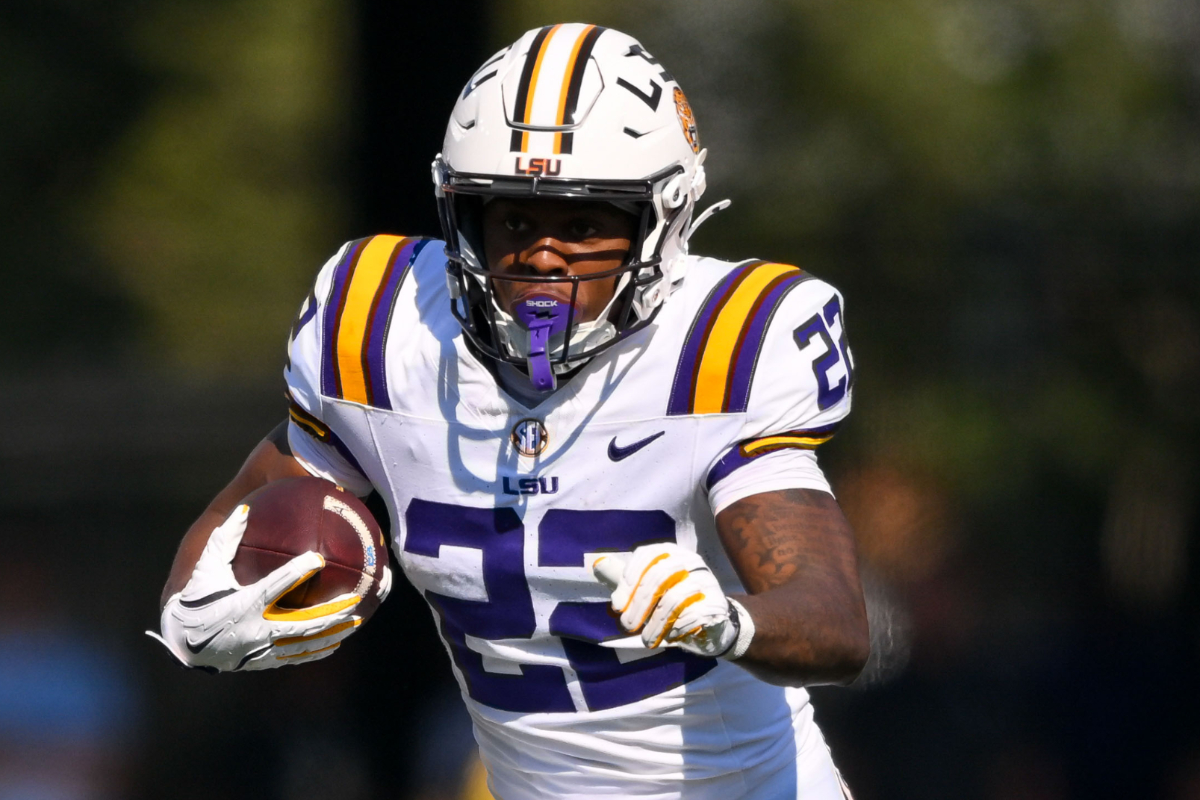
Harlem Berry (RB, LSU Tigers)
Expectation Versus Reality
Entered LSU as the consensus top running back in the 2025 class, Harlem Berry also had one of the most exciting devy profiles overall. An explosive, track-level athlete with true home-run ability, Berry projected as a potential difference-maker from day one. His combination of speed, receiving upside and big-play capability gave him one of the highest ceilings in the class, particularly in PPR formats. Even within a talented running back room alongside Caden Durham, there was a clear expectation that Berry’s talent would demand early involvement, but what followed was more complicated.
What Happened in Year 1
Berry’s freshman season can’t be evaluated without understanding the context around him. LSU’s run game was one of the least effective units in the country, averaging just 3.58 yards per carry. The offensive line struggled to create consistent lanes, and the overall structure of the offence failed to establish any rhythm on the ground. That environment limited both Berry and Durham, despite their individual talent.
Within that, Berry still carved out a meaningful role. He finished with 491 rushing yards on 104 carries, with his workload increasing significantly late in the season. In fact, he started the final stretch of games, taking advantage of both opportunity and coaching changes to establish himself as a central piece of the backfield.
The flashes aligned with his profile; Berry showed the burst and acceleration that made him such a coveted recruit, with the ability to create chunk plays when space was available. However, the same developmental questions from his scouting report were still visible, particularly around vision and navigating traffic behind an inconsistent offensive line. From a devy standpoint, this wasn’t a breakout season for Berry, but it wasn’t a disappointment either. It was production despite the environment.
What’s Changed Heading Into Year 2
The biggest shift for Harlem Berry isn’t just personnel, it’s philosophy. LSU enters 2026 under a new offensive direction with Lane Kiffin, who will bring a system built on tempo, spacing and creating mismatches. For a player like Berry, that matters. His skill set is best utilised in space, both as a runner and receiver, and the new scheme is designed to create exactly those conditions.
Berry himself has focused on adapting to that change. Reports from the offseason highlight an emphasis on adding size and improving stamina, both necessary for handling the demands of a faster-paced offense. There’s also a clear push to expand his role as a receiver, which aligns with his long-term devy appeal.
However, the situation isn’t without competition or risk. Caden Durham remains a significant presence in the backfield, and the current expectation is that LSU will deploy a committee approach rather than a true workhorse. Additionally, the offensive line is still a work in progress, meaning structural limitations may not be fully resolved. In short, the system is more favourable, but not yet proven.
2026 Outlook & Devy Lens
Berry is one of the more intriguing “ceiling versus structure” evaluations in this group. The upside case is clear. In a more functional offense, with increased space and a defined role in both the run and passing game, he has the profile to produce explosive plays and accumulate high-value touches. Few players in this class offer his combination of speed and receiving upside.
But the pathway isn’t clean. He’s unlikely to dominate volume in a shared backfield, and the offensive line remains a variable that could limit efficiency. There’s also the broader question of whether LSU’s offensive transition fully clicks in Year 1 under a new system.
This places Harlem Berry in a nuanced tier from a devy perspective. He’s a high-upside hold with situational dependency; he’s a player whose value could rise quickly if the offence stabilises, but who may remain volatile if structural issues persist. The talent hasn’t been in question at any point, but the environment has. Now, for the first time, there’s at least a pathway for the two to align.
RELATED: The Top 11 2026 College Football Freshmen Running Backs | Devy Fantasy Football
Final Thoughts: The Sophomore Step-Up Window
This is where devy evaluation becomes uncomfortable and valuable. A year from now, the picture should be much clearer.
Players like Gideon Davidson and Harlem Berry could be firmly established as central pieces of their offences, their value rising with consistent volume and defined roles. Dallas Wilson and Talyn Taylor, if healthy and integrated, could shift from projection to production, validating the traits that made them early devy targets.
That doesn’t mean immediate cut decisions, but it does mean reassessment. The signals to watch are straightforward. Is their role expanding? Are they earning high-value touches or targets? Are the same limitations still showing up? If the answer is consistently no, it may be time to move on before value erodes further. That’s the risk side of the equation.
The upside, however, is why we playdevy in the first place. When it does click and talent, opportunity and environment finally align, the value jump can be immediate. A player goes from theoretical upside to a tangible asset almost overnight and those who held through the uncertainty are the ones who benefit. That’s the balance.
The sophomore year isn’t about demanding a breakout; it’s about identifying who is actually moving toward one.
RELATED: The Top 8 2026 College Football Freshmen Quarterbacks | Devy Fantasy Football

Thanks for reading my Devy Watch article on The Sophomore Step-Up! For more Devy and College Fantasy Football content, follow me on Twitter/X @PoshplaysFF.
*Photo Credit: Steve Roberts – USA TODAY Sports*
