The curtain has only just fallen on the College Football National Championship, but with fewer than 100 days until the 2026 NFL Draft, it’s already time to look ahead. While the picture is far from complete, the road to Round 1 is officially underway, and the next few months will reshape draft boards across the league. Between the All-Star Bowl Games, the NFL Combine, individual Pro Days, coaching changes and the chaos of free agency, plenty will change before the draft kicks off on April 26, 2026, in Pittsburgh, Pa.
This mock draft reflects where things stand right now, using a blend of projected team needs and my current evaluations of each prospect. Trades are almost inevitable in the first round, but rather than guessing the movement, this mock focuses strictly on player-team fits as the landscape currently stands.

Phil Cartlich’s 2026 NFL Mock Draft 1.0: First-Round Picks & Predictions
1. Las Vegas Raiders: Fernando Mendoza (QB, Indiana)
Fernando Mendoza has authored one of the most memorable seasons in recent college football history. An undefeated run capped by a National Championship and a Heisman Trophy has solidified him as the clear headliner of the 2026 NFL Draft quarterback class. Mendoza consistently rose to the occasion, delivering in high-leverage moments and showcasing the calm, controlled demeanor teams covet at the position. That poise was evident on the biggest stage as he led the Hoosiers past Miami, with Las Vegas Raiders part-owner Tom Brady in attendance to witness his command firsthand.
The Raiders are entering another reset following the failed reunion of Pete Carroll and Geno Smith, and they now sit in a prime position to secure a long-term answer at quarterback and the top prospect offers exactly that profile. He is mature, composed and surgical from the pocket, winning with timing, accuracy and advanced processing rather than chaos. For a franchise long defined by instability, Fernando Mendoza represents a chance at real, sustainable direction under center.
2. New York Jets: Arvell Reese (LB, Ohio State)
The New York Jets also enter the 2026 NFL Draft needing a quarterback, but circumstances dictate patience. With Dante Moore opting to return to school, there simply isn’t another passer worthy of this selection. Fortunately, the Jets are positioned to play the long game. Armed with significant draft capital over the next two years, they can continue building the roster and target a quarterback in 2027 when their surrounding infrastructure is better suited to support a young signal-caller.
That roster-building must begin on defense. New York finished 31st in the league in sacks and dead last in interceptions in 2025, failing to record a single pick across 17 games. That lack of disruption made life far too easy for opposing offenses and Arvell Reese offers an immediate remedy. The biggest breakout player in college football last season, Reese transitioned from an off-ball role to edge rusher and dominated in his new position. His instincts, first-step burst and versatility jump off the tape, and he produced 69 tackles, 9 tackles for a loss and 6.5 sacks in 14 games. His ability to move around the front brings a Micah Parsons-like presence capable of transforming a struggling defense.
3. Arizona Cardinals: Rueben Bain Jr. (EDGE, Miami)
Another team hoping to find long-term quarterback answers near the top of the draft is the Arizona Cardinals, but with no passer worthy of the third overall pick, Arizona instead leans into roster strength. After heavy defensive investment last year, the Cardinals continue that approach by selecting Rueben Bain Jr., passing on offensive tackle to secure a potential game-wrecker off the edge.
Bain brings an NFL-ready pass-rush profile built on traits. His elite first step routinely beats offensive tackles to the point of attack, while his violent hands and relentless motor keep constant pressure throughout the snap. At 270 pounds, he combines impressive flexibility and bend with excellent pad-level discipline, allowing him to win with both speed and power. The Miami prospect also offers a diverse pass-rushing arsenal and holds up well against the run. His production backs it up, with 9.5 sacks and 17.5 tackles for loss in 2025, including a dominant National Championship performance. Pairing Reuben Bain with Josh Sweat off the edge and Walter Nolen inside would give Arizona one of the league’s most formidable defensive fronts.
4. Tennessee Titans: Francis Mauigoa (OT, Miami)
With the fourth overall pick, the Tennessee Titans face a defining decision: reinforce a struggling defense or protect their most important asset. After finishing 27th in the league in sacks allowed last season, Tennessee chooses the latter, selecting offensive tackle Francis Mauigoa to safeguard second-year quarterback Cam Ward, the franchise’s top investment from the 2025 draft.
Mauigoa steps in as a plug-and-play starter with the physical profile teams covet at left tackle. Lining up opposite JC Latham, he brings size, strength and movement skills that immediately raise the floor of Tennessee’s front. His power at the point of attack stands out most in the run game, where he consistently creates movement and opens lanes. In pass protection, his technique continues to evolve, but his balance, foot speed and ability to absorb contact give him a strong foundation. Francis Mauigoa offers both immediate value and long-term upside as a potential franchise blindside protector.
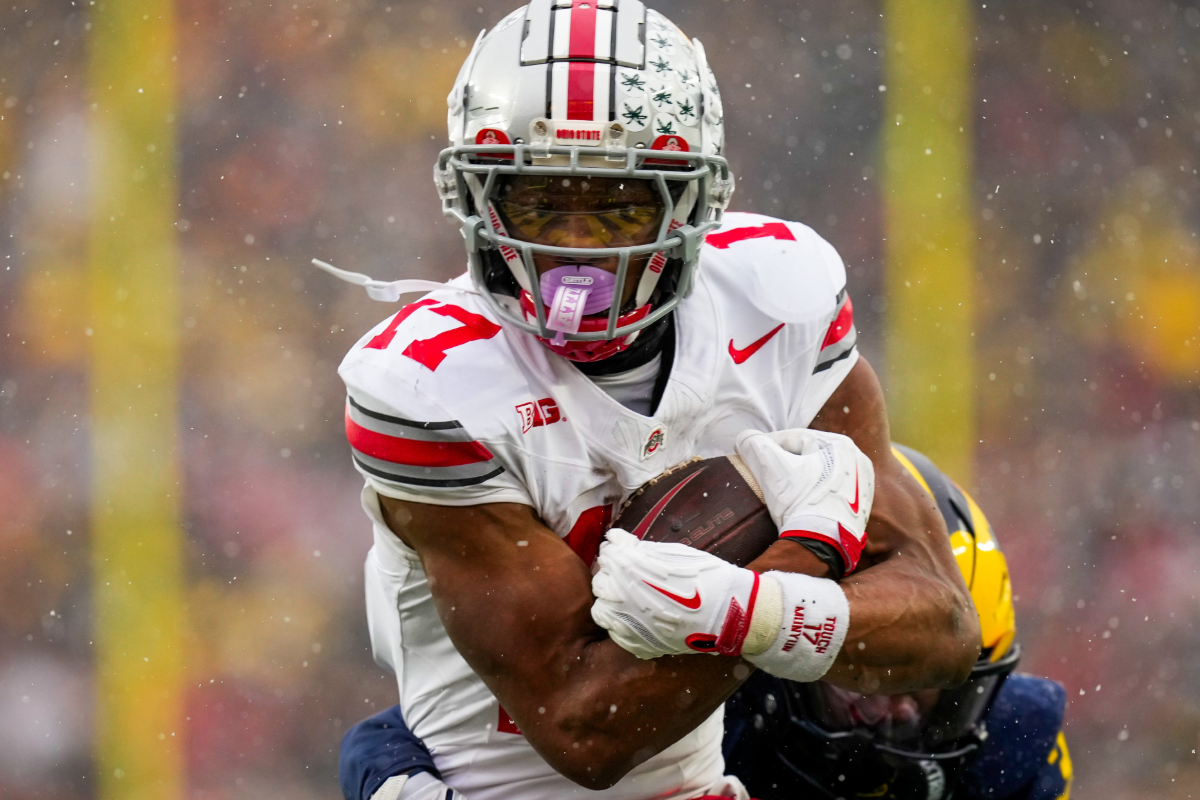
5. New York Giants: Carnell Tate (WR, Ohio State)
With the fifth overall pick, the New York Giants choose to invest in their young quarterback by upgrading his supporting cast. Entering year two with Jaxson Dart under center, New York had multiple paths available, including adding protection opposite Andrew Thomas. Instead, the Giants opt to elevate Dart’s play by selecting wide receiver Carnell Tate, giving the offense another high-level weapon.
With Malik Nabers returning from injury and Wan’Dale Robinson set to hit free agency, wide receiver stands out as a logical and necessary investment. Tate narrowly edges out other elite options on the board due to how cleanly his skill set complements Nabers. Where the veteran wins with explosiveness and physical dominance, the rookie thrives with polish. He’s a refined route runner who understands leverage, varies his tempo and consistently finds space underneath and in the intermediate areas. Carnell Tate doesn’t require schemed touches to be effective and excels at moving the chains, punishing defenses that tilt coverage toward Nabers. The result is a balanced, quarterback-friendly duo that can stabilize and elevate the Giants’ passing attack.
6. Cleveland Browns: Spencer Fano (OT, Utah)
With their early first-round selection, the Cleveland Browns opt to reinforce the foundation of their offense by selecting offensive lineman Spencer Fano, knowing they can address a skill position later when they pick again. That flexibility allows Cleveland to stay true to its identity in the trenches while still planning to add playmakers on Day 1.
Fano brings immediate value because of his versatility and physical profile. He has experience playing on both sides of the offensive line at Utah and possesses the size, strength and technical refinement to handle either tackle spot at the NFL level. If needed, he also projects as a seamless transition candidate to guard, giving the Browns options as they navigate their lineup. With Cam Robinson and Jack Conklin both set to hit free agency, Cleveland must plan for turnover up front.
Pairing Spencer Fano with Dawand Jones would give the Browns a young, powerful tackle tandem capable of anchoring the line for years. Fano’s power in the run game and reliable technique in pass protection align perfectly with Cleveland’s physical offensive approach, making him a logical cornerstone pick.
7. Washington Commanders: David Bailey (EDGE, Texas Tech)
A year after reaching the NFC Championship Game, the Washington Commanders find themselves drafting inside the top ten following a season heavily impacted by injuries. Washington’s 2025 plan centered on accelerating the development of Jayden Daniels by adding veteran help on offense, but the results fell short on both sides of the ball. While another offensive weapon would be appealing, the more pressing long-term concern lies in the lack of consistent defensive disruption.
The Commanders struggled to pressure quarterbacks, relying on Von Miller to lead the team in sacks despite his advanced age and expiring contract. That makes edge rusher a clear priority. David Bailey brings exactly the type of juice this unit is missing. He enters the league with a reputation as a high-impact pass rusher, offering immediate situational value with the upside to grow into an every-down defender. Bailey’s explosive get-off, flexibility around the edge, and natural closing speed routinely overwhelm blockers. His production speaks for itself, with double-digit sacks, frequent backfield disruption, and one of the strongest pressure rates in the class. David Bailey gives Washington a young, ascending pass rusher to help reset the identity of the defense.
8. New Orleans Saints: Jeremiyah Love (RB, Notre Dame)
With the eighth overall pick, the New Orleans Saints opt to add one of the most dynamic playmakers in the class by selecting Jeremiyah Love. Positional value be damned, Love stands out as one of the best pure football players available. After finding stability at quarterback with Tyler Shough, New Orleans can now shift its focus toward surrounding him with versatile, difference-making weapons.
Wide receiver was firmly in play, especially following the departure of Rashid Shaheed and the release of Brandin Cooks, but Love brings a unique element the roster currently lacks. With Alvin Kamara beginning to show signs of decline, Love offers a seamless transition as a modern offensive weapon. While Chris Olave remains the focal point in the passing game, Love’s value lies in his versatility. He can line up in the slot, run legitimate routes and threaten defenses downfield rather than functioning as a traditional check-down option. In Kellen Moore’s offense, Jeremiyah Love’s flexibility creates constant matchup problems, making him an immediate impact player capable of scoring from anywhere on the field.
9. Kansas City Chiefs: Peter Woods (DT, Clemson)
With the ninth overall pick, the Kansas City Chiefs pivot after narrowly missing out on an offensive difference-maker. Instead, they double down on what they do best: building dominance in the trenches. While the absence of Jeremiyah Love leaves Kansas City still searching for added explosiveness in the run game, the expectation remains that the Chiefs will be firmly back in the playoff mix. With that in mind, adding a true impact player elsewhere becomes the priority.
Peter Woods fits that bill perfectly. Pairing him with Chris Jones along the interior creates a nightmare scenario for opposing offenses. Woods brings a rare blend of burst, strength and refinement that allows him to disrupt plays before they fully develop. His ability to win immediately off the snap, collapse pockets with power and hold up against the run gives him the profile of a long-term defensive cornerstone. While there is still room for growth in turning pressure into consistent finishes, the upside is immense. Woods has the traits to become a game-altering presence who demands extra attention on every snap. With Jones already commanding double teams, Woods’ arrival also unlocks alignment flexibility, allowing Kansas City to move pieces around and maximize mismatches across the defensive front.
10. Cincinnati Bengals: Caleb Downs (S, Ohio State)
With the tenth overall pick, the Cincinnati Bengals make one of the simplest decisions on the board by selecting safety Caleb Downs. While most teams supporting an elite quarterback look to add weapons or offensive line help, Cincinnati’s issues are far more apparent on the other side of the ball. The Bengals’ defense cratered in 2025, finishing near the bottom of the league in overall efficiency, yards allowed and points conceded. They struggled mightily against the run and surrendered touchdowns at an alarming rate, putting constant pressure on an offense led by Joe Burrow, Ja’Marr Chase and Tee Higgins.
Downs brings immediate credibility and playmaking ability to a defense in desperate need of both. Widely viewed as one of the best overall prospects in the class, he combines elite football intelligence with high-end athleticism. A Day 1 contributor at Alabama before winning a national title at Ohio State, the prospect processes quickly, plays with excellent anticipation and consistently arrives at the ball on time. He’s dependable in coverage, fearless against the run and a sure tackler in space. For a Bengals defense that allowed some of the league’s worst efficiency numbers, Caleb Downs is exactly the stabilizing presence they need on the back end.
11. Miami Dolphins: Makai Lemon (WR, USC)
With the 11th overall pick, the Miami Dolphins take a proactive approach to reshaping their offense by selecting wide receiver Makai Lemon. Uncertainty at quarterback already clouds Miami’s short-term outlook, but the situation at wide receiver adds even more urgency. Tyreek Hill carries a massive $51.9 million cap hit next season, and moving on from him would free up $23.65 million in cap space. Given those financial realities and ongoing health concerns, it’s increasingly difficult to project Hill as part of the Dolphins’ long-term plans.
Lemon offers a clean, forward-thinking solution. The Biletnikoff Award winner profiles as an intelligent, versatile pass catcher capable of supporting whoever lines up at quarterback. While Jordyn Tyson was strongly considered, the USC prospect’s ability to win both inside and outside ultimately separates him. His technical foundation, route precision and consistent separation suggest a smoother transition to the professional level than most receiver prospects. Makai Lemon understands how to manipulate coverage, create throwing windows and play on schedule. That blend of reliability and versatility gives Miami flexibility in deployment and provides a cost-controlled offensive centerpiece as the roster evolves.
12. Dallas Cowboys: Keldric Faulk (EDGE, Auburn)
With the 12th overall pick, the Dallas Cowboys address a glaring need along the defensive front by selecting edge defender Keldric Faulk. Dallas reshaped its defense last season in dramatic fashion, moving on from Micah Parsons in a stunning trade to the Green Bay Packers, and the unit was further depleted by the tragic loss of Marshawn Kneeland. With rookie Donovan Ezeiruaku now part of the rotation, the Cowboys must rebuild depth and find a new foundational presence up front.
Faulk brings the body type and play style that defensive coaches build around. He plays with heavy hands, excellent strength and the balance to stay effective through contact, making him a reliable presence against the run. At the same time, his athletic profile allows him to stay active and disruptive when the game speeds up. He isn’t limited to obvious passing situations and can stay on the field regardless of down or distance. That versatility will give Dallas flexibility in how they deploy their front, allowing Keldric Faulk to line up head-up on the tackle early before shifting alignments to create pressure when offenses are forced to throw. His ability to impact games without being scheme-dependent gives the Cowboys a durable, long-term piece to help reestablish their defensive identity.
13. Los Angeles Rams: Jordyn Tyson (WR, Arizona State)
With the 13th overall pick, acquired in last year’s trade with the Falcons, the Los Angeles Rams add another explosive weapon to their offense by selecting wide receiver Jordyn Tyson. Puka Nacua has firmly established himself as the engine of the passing game, and while Davante Adams continues to play at a high level, his career is entering its later stages. Los Angeles needs to inject more speed and vertical juice into the receiver room, and Tyson answers that call.
The Arizona State rookie brings a different dimension to the offense with his acceleration, deep speed and ability to create explosive plays after the catch. He has the tools to stretch defenses horizontally and vertically, forcing safeties to respect his presence and opening space elsewhere. Tyson’s skill set fits seamlessly into Sean McVay’s offense, which thrives on motion, spacing and timing. His ability to win in space and threaten defenses downfield prevents opponents from loading the box or sitting on intermediate routes. He doesn’t require high-volume targets to make an impact, making Jordyn Tyson an ideal complementary piece who enhances the overall structure of the Rams’ offense while providing a long-term succession plan at wide receiver.
14. Baltimore Ravens: Sonny Styles (LB, Ohio State)
With the 14th overall pick, the Baltimore Ravens once again lean into their long-standing draft philosophy: trust the board and take the difference-maker. Baltimore has clear needs at edge rusher and along the interior offensive line, but neither position offers value that matches this draft spot. Instead, the decision comes down to two elite defenders: cornerback Jermod McCoy, whose 2024 tape ranked among the best in the country, and off-ball linebacker Sonny Styles.
While corner may appear to be the more pressing need given the state of the Ravens’ depth chart heading into 2026, Styles’ talent and fit are simply too strong to pass up. Under new head coach Jesse Minter, Baltimore’s defense is built on speed, disguise and versatility at the second level, and Styles embodies that vision. He’s a rangy, explosive linebacker with the instincts to diagnose quickly and the athleticism to erase space in coverage, chase plays sideline to sideline and contribute as a pressure piece.
Pairing Sonny Styles with Roquan Smith allows Baltimore to maximize both players, freeing Smith to play downhill while Styles handles pursuit and matchup responsibilities. In Minter’s system, the rookie isn’t just a linebacker; he’s a movable defensive weapon, and the kind of high-impact talent the Ravens have built elite defenses around for years.
15. Tampa Bay Buccaneers: Kenyon Sadiq (TE, Oregon)
With the 15th overall pick, the Tampa Bay Buccaneers land a player whose skill set feels tailor-made for their offense by selecting tight end Kenyon Sadiq out of Oregon. Tampa Bay has been searching for a true impact presence at the position, and while Cade Otton showed promise earlier in his career, he faded from the offense last season and now heads toward free agency. Sadiq offers exactly what the Buccaneers have been missing.
At 6-foot-3 with rare explosiveness, Sadiq creates constant matchup problems for defenses. He has the burst to threaten seams, the body control to win in tight spaces and the strength to finish through contact after the catch. For Baker Mayfield, that means a reliable target who can be schemed into space on early downs or trusted in the red zone to win contested throws. Beyond the passing game, he brings legitimate value as a blocker, playing with effort and physicality in the run game. Kenyon Sadiq’s blend of athleticism, versatility and toughness gives Tampa Bay a true three-down tight end with Pro Bowl upside and immediate offensive impact.
16. New York Jets: Jermod McCoy (CB, Tennessee)
With the 16th overall pick, acquired from the Colts in the Sauce Gardner trade, the New York Jets turn their attention to rebuilding the back end of the defense. While quarterback remains a long-term question, that responsibility is expected to fall to a veteran stopgap in 2026. This selection is about replacing the void left by Gardner and restoring a true lockdown presence in the secondary.
Jermod McCoy steps into that role as one of the most refined corners in the class. Assuming his medical evaluations check out, he stands out as the top cornerback on the board. McCoy’s tape shows exceptional short-area quickness and the ability to stay glued to receivers through the route stem. His footwork is sharp, his transitions are seamless and he consistently drives on the football with urgency. Those traits translated into production, as he posted six interceptions and 16 pass breakups during the 2024 season. He also brings physicality against the run, playing with sound leverage and dependable tackling in space. If his 2024 trajectory continues, his blend of athleticism, instincts, and ball skills gives the Jets a potential long-term CB1 capable of anchoring the defense for years to come.
17. Detroit Lions: Mansoor Delane (CB, LSU)
With the 17th overall pick, the Detroit Lions continue their pursuit of stability in the secondary by selecting cornerback Mansoor Delane. Detroit has been searching for answers at cornerback for multiple offseasons, and that urgency remains. Terrion Arnold has yet to deliver consistent returns, and with Amik Robertson approaching free agency, adding a dependable coverage defender becomes a priority.
Delane brings a polished, assignment-sound skill set that fits what the Lions need. He plays with strong instincts and a clear understanding of route concepts, allowing him to stay a step ahead of receivers. His production reflects that awareness, consistently getting his hands on the football and limiting efficiency when targeted. Comfortable in both man and zone looks, he rarely gives quarterbacks easy windows and routinely closes space with discipline and timing. His final college season marked a major step up in competition after transferring to the LSU Tigers, and he handled the transition with ease, proving his game translates against elite talent. At 6-foot, 190 pounds, Mansoor Delane projects as an immediate contributor who can step into Detroit’s lineup and help bring much-needed reliability to the secondary.
18. Minnesota Vikings: Kayden McDonald (DT, Ohio State)
With the 18th overall pick, the Minnesota Vikings begin planning for the next phase of their defensive line. Minnesota leaned on experience last offseason by bringing in Javon Hargrave and Jonathan Allen, but those moves were always short-term answers. As both veterans move deeper into their careers, the focus shifts toward securing a younger interior presence who can grow into a central role. Pairing a developing talent with Jalen Redmond allows the Vikings to stabilize the position beyond the immediate window.
Kayden McDonald arrives after a massive breakout campaign that earned him Big Ten Defensive Lineman of the Year honors. After being largely a non-factor earlier in his career, he exploded once given a starting role, showcasing dominant interior play over a full season. The emerging star brings rare power and burst for his size, consistently holding his ground against the run while flashing the ability to penetrate gaps and finish plays. His motor and awareness allow him to stay involved snap to snap, tracking the ball rather than simply occupying space.
In Minnesota’s 3-4 base defense, McDonald projects as an ideal interior anchor. His ability to absorb double teams and control gaps complements Redmond’s quickness and penetration, giving the Vikings balance inside rather than redundancy. While his pass-rush refinement will be the key developmental focus, the foundation is in place for Kayden McDonald to become a long-term fixture in the heart of the Vikings’ defense.
19. Carolina Panthers: CJ Allen (LB, Georgia)
With the 19th overall pick, the Carolina Panthers address the heart of their defense by selecting linebacker CJ Allen out of Georgia. Carolina enters the 2026 NFL Draft with uncertainty at the position, as Christian Rozeboom approaches free agency and questions remain about whether Trevin Wallace can be a long-term answer. Given the strength of this linebacker class, the value and timing align well for the Panthers to invest.
CJ Allen brings a decisive, downhill style that fits seamlessly into an NFL defense. He plays with excellent trigger speed, diagnosing plays quickly and attacking without hesitation. That approach led to strong production in 2025, where he consistently found the football and finished plays. Allen also offers value as a blitzer, showing the ability to contribute pressure when called upon. What elevates his profile is the way his athleticism pairs with improving football intelligence. He processes information rapidly, allowing him to play fast and minimize false steps. That awareness helps offset areas of his game still developing, particularly in coverage. Having operated within Georgia’s pro-style defensive system, CJ Allen should transition smoothly to the next level and projects as an immediate contributor with room to grow into a defensive leader.
20. Dallas Cowboys: Anthony Hill Jr. (LB, Texas)
With the 20th overall pick, acquired from the Green Bay Packers in the Micah Parsons trade, the Dallas Cowboys continue rebuilding the core of their defense by selecting linebacker Anthony Hill Jr. A Texas native who starred for the Texas Longhorns, Hill stays in-state as he steps into a clear position of need.
Dallas has lacked consistency at linebacker, with Kenneth Murray failing to secure a long-term role and Marist Liufau yet to develop into a dependable option. That creates an immediate opening alongside DeMarvion Overshown. Hill brings explosive downhill power paired with true sideline-to-sideline range, allowing him to impact plays at every level. He plays with urgency, physicality, and advanced instincts, consistently arriving at the football in key moments. At roughly 235 pounds, his speed stands out, and his tackling technique allows him to play bigger than his frame. Anthony Hill projects as an immediate defensive tone-setter with Pro Bowl-level upside.
21. Pittsburgh Steelers: Ty Simpson (QB, Alabama)
With the 21st overall pick, the Pittsburgh Steelers take a calculated swing on the most polarizing quarterback in the class by selecting Ty Simpson out of Alabama. Aaron Rodgers helped keep Pittsburgh competitive in the AFC North, but that was always a temporary bridge. Long term, the Steelers must solve the position themselves, and few franchises are better equipped to absorb risk than one built on organizational stability, patience and a run-first identity.
Ty Simpson’s evaluation is a tale of extremes. Early in his first season as a starter, he looked like a future franchise quarterback, showing advanced command, processing and accuracy while carving up top SEC competition. He operated complex concepts with confidence, protected the football and produced at an elite level without much help from the run game. That stretch put his mental acuity and anticipation firmly on the map.
The concerns are real, however. As defenses adjusted and Alabama’s supporting cast faltered, Simpson struggled to maintain efficiency, exposing the limits of his physical tools and experience. With only a small sample of starts, he remains a projection rather than a finished product. That’s exactly why Pittsburgh makes sense. In a structured offense that emphasizes the ground game, Ty Simpson can develop at the proper pace, especially if Rodgers returns. If it clicks, the Steelers may have found their long-term answer.
22. Los Angeles Chargers: Olaivavega Ioane (G, Penn State)
With the 22nd overall pick, the Los Angeles Chargers continue reshaping their offense in the image of Jim Harbaugh, selecting interior offensive lineman Olaivavega Ioane out of Penn State. Harbaugh’s best teams have always been built from the line of scrimmage outward, and while getting Joe Alt and Rashawn Slater healthy stabilizes the tackle spots, questions remain inside. Mekhi Becton failed to lock down right guard and Bradley Bozeman is set to test free agency, leaving a clear opening on the interior.
Olaivavega Ioane offers exactly the type of presence Harbaugh and offensive line coaches covet. He plays with a powerful base, excellent play strength and enough mobility to stay effective in both the run and pass game. His game is built on balance and control rather than flash, giving him a high floor and immediate starting potential. While selecting a guard this early may not generate headlines, his reliability makes the pick easy to justify. He consistently sustains blocks, keeps the pocket clean, and has not surrendered a sack since 2023. That kind of dependability is invaluable for an offense led by Justin Herbert, and Olaivavega Ioane projects as a long-term stabilizer capable of anchoring the Chargers’ interior for years to come.
23. Philadelphia Eagles: Caleb Lomu (OT, Utah)
With the 23rd overall pick, the Philadelphia Eagles once again think long-term in the trenches by selecting offensive tackle Caleb Lomu out of Utah. Philadelphia has built its identity around elite line play, and succession planning at premium positions has always been central to their roster construction. Lane Johnson remains a cornerstone of the offense, but with age becoming a factor, preparing for the future at right tackle is essential. Protecting Jalen Hurts and maintaining dominance up front remain non-negotiable priorities.
Caleb Lomu represents a classic Eagles bet on upside and development. He brings rare athletic traits for the position, with movement skills and natural balance that hint at a future high-end starter. While he’s still refining his technique and adding functional strength, his pass protection instincts already stand out. Philadelphia’s environment makes this an ideal landing spot. With veteran leadership in place and one of the league’s best offensive line development pipelines, Lomu can be brought along at the right pace. The Eagles don’t need him to be a finished product immediately; they can invest in his growth and potentially emerge with a long-term bookend tackle capable of anchoring the line for years to come.
24. Cleveland Browns: Avieon Terrell (CB, Clemson)
With the 24th overall pick, acquired from the Jacksonville Jaguars, the Cleveland Browns continue to restock their secondary by selecting cornerback Avieon Terrell. That selection traces back to Cleveland’s decision to move off the No. 2 overall pick in 2025, a trade that allowed the Jaguars to draft Travis Hunter and gave the Browns valuable long-term assets. With Jacksonville reaching the playoffs in 2025, the pick lands late in the first round, but still offers Cleveland a chance to add a high-impact defender.
Cornerback remains a priority. An in-season trade for Tyson Campbell helped offset the loss of Greg Newsome II, but Denzel Ward’s injury history and rising cost make long-term planning essential. Terrell fits that plan well. He excels in man coverage, playing with confidence and urgency at the line of scrimmage. His quick hips and closing burst allow him to stay attached to receivers and attack the football when it’s in the air. His production reflects that play style, breaking up passes and consistently creating turnovers. In an aggressive, man-heavy scheme, Avieon Terrell projects as a reliable, cost-controlled starter who brings physicality and competitiveness despite modest size.
25. Chicago Bears: Kadyn Proctor (OT, Alabama)
With the 25th overall pick, the Chicago Bears solidify the most important position on the offensive line by selecting left tackle Kadyn Proctor out of Alabama. Chicago rotated through multiple options on the blind side last season, and while Ozzy Trapilo showed growth late in the year, his long-term projection fits better on the right side. Protecting Caleb Williams must remain the priority, and Proctor gives the Bears a true solution.
Kadyn Proctor is a rare physical specimen, blending overwhelming size and strength with movement skills that don’t match his massive frame. He consistently uproots defenders in the run game, generating displacement and setting a physical tone snap after snap. What stands out most is how he sustains leverage through contact, driving defenders backward rather than settling for stalemates. As a pass protector, he already shows the anchor and recovery ability to handle NFL edge rushers, even as his technique continues to evolve. Kadyn Proctor can be an immediate difference-maker in this downhill run scheme, while also developing into a long-term cornerstone. With continued refinement under Ben Johnson, Chicago is betting on elite traits, steady progression and a tackle capable of anchoring the line for the next decade.
26. Buffalo Bills: Denzel Boston (WR, Washington)
With the 26th overall pick, the Buffalo Bills turn their attention back to a lingering issue by selecting wide receiver Denzel Boston. Buffalo entered last season seemingly confident in its pass-catching group, but the results told a different story. Another playoff exit only intensified the concern that the offense isn’t doing enough to maximize Josh Allen’s prime years. Since trading Stefon Diggs in 2024, Buffalo hasn’t had a true No. 1 option or a receiver consistently threatening defenses downfield.
Finding impact wideouts late in the first round is never easy, but Denzel Boston offers a skill set that translates. He’s a disciplined route runner who plays with strength and body control, consistently creating separation and winning contested catches. His production near the goal line stands out, finishing last season with 11 touchdowns, seven of them in the red zone. The Washington wide receiver won’t need to be force-fed targets to matter; his presence alone raises the floor of the unit. For a Bills offense searching for reliability and toughness at receiver, Denzel Boston provides immediate help and a much-needed complement to Josh Allen’s game.
27. San Francisco 49ers: Emmanuel McNeil-Warren (S, Toledo)
With the 27th overall pick, the San Francisco 49ers pivot from offense to defense after missing out on a wide receiver and add safety Emmanuel McNeil-Warren to address one of the roster’s quieter concerns. San Francisco could use more stability on the back end, especially with Jason Pinnock nearing free agency and Ji’Ayir Brown under contract only through 2026. Adding talent and flexibility at the position makes sense for a defense that thrives on versatility.
McNeil-Warren brings an intriguing blend of size, explosiveness and physicality. At over 6-foot-3 with long arms, he’s a force when playing downhill, closing space quickly and finishing tackles with authority. His burst and strength allow him to fight through blocks and disrupt plays near the line of scrimmage. However, his game isn’t limited to support duties. He moves well in space, shows comfort operating in split-safety looks and displays strong instincts in the red zone, where anticipation matters most. While he may never profile as a true single-high eraser, Emmanuel McNeil-Warren offers the tools to become a dependable three-down safety. In a creative defensive system like San Francisco’s, his length, physical edge, and improving coverage skills give the 49ers a versatile chess piece with long-term value.
28. Houston Texans: Blake Miller (OT, Clemson)
With the 28th overall pick, the Houston Texans focus on stabilizing the foundation of their offense by selecting offensive tackle Blake Miller out of Clemson. C.J. Stroud has struggled to find a consistent rhythm since his rookie breakout, often operating behind an offensive line that failed to provide reliable protection. Improving that unit remains a top priority after the Texans finished in the bottom third of the league up front in 2025.
Houston leaned heavily on young linemen last season, starting a rookie at tackle and expecting internal growth from former high-upside interior players that never fully materialized. While the line avoided complete collapse, it still lacked consistency both inside and on the edges and Blake Miller offers an intriguing solution. Primarily a right tackle at Clemson, he brings the size and athletic traits teams look for, along with enough positional flexibility to project across the line. His brief exposure on the left side showcased adaptability and comfort in unfamiliar situations.
What stands out most is how smoothly Miller moves for his size. His coordination and balance give him a high developmental ceiling, even as his technique continues to evolve. With proper coaching, Houston is betting that his natural movement skills and football awareness can be refined into long-term stability for Stroud’s protection.
29. Los Angeles Rams: Brandon Cisse (CB, South Carolina)
With the 29th overall pick, the Los Angeles Rams address a looming roster issue by selecting cornerback Brandon Cisse. The Rams are heading toward an offseason of turnover in the secondary, with multiple veterans potentially departing and limited proven options under contract on the outside. That uncertainty makes cornerback one of the most pressing long-term needs on the roster, and waiting any longer risks leaving the position exposed.
Brandon Cisse brings the type of athletic profile teams look for when betting on upside at corner. He plays fast, stays patient through routes and consistently positions himself to challenge throws even when quarterbacks avoid him. While his interception numbers don’t reflect a true ball hawk, his ability to stay in phase and disrupt receivers shows up repeatedly on tape. The South Carolina CB is most comfortable in man coverage, where his length and smooth change of direction allow him to mirror downfield and recover when tested. He’s physically ready to line up outside early in his career, with the tools to grow into a matchup corner capable of handling top assignments. With strong coaching and refinement, Brandon Cisse offers Los Angeles an immediate starter and a long-term solution in a secondary undergoing change.
30. Denver Broncos: Caleb Banks (DT, Florida)
With the 3oth overall pick, the Denver Broncos face a genuine fork in the road. Upgrading the interior offensive line was firmly on the table, especially with Ben Powers dealing with injury and contract uncertainty, and Alex Palczewski profiling more as a solid stopgap than a long-term answer. Defensive line depth was the other option, and ultimately Denver leans into sustaining what already makes this team dangerous.
Caleb Banks becomes the choice as a forward-looking investment in the trenches. Injuries limited his most recent season, but his 2024 tape shows a disruptive interior presence capable of collapsing pockets and controlling the run. At 6-foot-6 and roughly 330 pounds, Banks brings rare size paired with surprising lateral agility, allowing him to clog lanes, shed blocks, and push plays backward. His length creates issues for interior linemen, particularly as a developing pass rusher. With John Franklin-Myers playing on an expiring deal, Denver wisely plans ahead. Learning behind Zach Allen, Banks can be eased into the rotation and developed into a long-term contributor who helps keep the Broncos’ defense among the league’s elite.
At the time of publication, the Super Bowl has yet to take place. The order of the final two picks has been selected using the order at Tankathon.
31. New England Patriots: Cashius Howell (EDGE, Texas A&M)
With the 31st overall pick, the New England Patriots look to inject more juice into their pass rush by selecting edge defender Cashius Howell out of Texas A&M. Mike Vrabel has helped engineer a rapid turnaround, but even with a strong defensive foundation in place, consistent pressure off the edge remains an area for growth. New England finished near the bottom third of the league in sacks and pressure rate, and the potential departure of K’Lavon Chaisson would only magnify that concern.
Howell brings upside that’s difficult to ignore this late in the first round. He’s an explosive edge presence with a quick first step, natural bend and a growing arsenal of pass-rush counters, production that translated into 11.5 sacks this past season. His path from the MAC to the SEC speaks to his ability to scale up against stronger competition, though questions remain about how he holds up when offenses run directly at him or scheme protections his way. That risk is real, but so is the payoff. In a disciplined, developmental environment like New England’s, Cashius Howell doesn’t need to be rushed into a full-time role. If Vrabel and his staff bring him along properly, the rookie edge has the tools to become a long-term difference-maker rather than just a situational rusher.
32. Seattle Seahawks: Emmanuel Pregnon (G, Oregon)
With the 32nd overall pick, the Seattle Seahawks close out the first round by addressing one of the most pressing weaknesses on the roster, selecting guard Emmanuel Pregnon out of Oregon. The interior offensive line has been a problem area for Seattle, particularly at right guard, where Anthony Bradford has struggled to provide consistent pass protection. That instability has allowed interior pressure to disrupt the pocket and limited the offense’s ability to operate efficiently between the tackles, often putting Sam Darnold under unnecessary duress.
Pregnon offers an immediate upgrade, playing with strength, balance and polished hand usage, giving him a pro-ready profile that should translate quickly. In the run game, he generates movement at the point of attack, helping create clean interior lanes rather than forcing everything to the edge. As a pass protector, his anchor stands out against power rushers, and his awareness allows him to recognize twists and stunts. While he lacks positional flexibility and will need to adjust to NFL speed, Emmanual Pregnon’s experience and consistency provide Seattle with a dependable, physical presence capable of starting from Day 1 and stabilizing the interior of the offensive line.
RELATED: Mid-Season 2026 Dynasty Rookie Mock Draft | Superflex, TE Premium

Thanks for reading my article on “Phil Cartlich’s NFL Mock Draft 1.0 First-Round Picks and Predictions.” For more Devy and College Fantasy Football content, follow me on Twitter/X @PoshplaysFF.
*Photo Credit: Samantha Madar/Columbus Dispatch – USA TODAY Sports*
